_1LSK4o.webp)
Key Takeaways
- The 2026 Default: Cross-platform frameworks handle 80–90% of commercial apps with near-native performance.
- Major Cost Savings: Cuts initial development costs by 30–50% and 3-year maintenance by 25–35%.
- Framework Guide:
- Flutter: Best for visual consistency, animation-heavy UIs, and new codebases.
- React Native: Ideal for teams with JavaScript/React talent and content-heavy apps.
- Kotlin Multiplatform (KMP): Best for sharing business logic while keeping 100% native platform UIs.
- When to Go Native: Only necessary for deep hardware integration (LiDAR/AR), platform extensions (CarPlay/watchOS), or heavy graphics.
What Is the Difference Between Native and Cross-Platform Mobile Development?
Native mobile development means writing separate codebases for each platform. iOS apps are built in Swift or Objective-C, and Android apps are built in Kotlin or Java. Cross-platform development uses a single shared codebase built with Flutter, React Native, or Kotlin Multiplatform (KMP), compiling and running on both platforms from a single set of source files.
In 2026, the question is no longer "is cross-platform good enough?" Cross-platform frameworks have matured to cover the needs of roughly 80 to 90% of commercial mobile applications. The real question is which approach and which specific framework fits your team, timeline, and product requirements.
Is Cross-Platform Performance Good Enough in 2026?
Cross-platform performance in 2026 is close enough to native for the vast majority of applications. The early reputation of cross-platform apps as slow or visually inconsistent was earned in a different era. Three specific improvements have closed the gap.
Flutter compiles Dart code ahead-of-time to native ARM machine code and uses the Impeller rendering engine, which fully replaced Skia on iOS, to deliver consistent 60 to 120fps with startup times under 300ms on modern devices.
React Native's New Architecture and Hermes V1 eliminated the JavaScript bridge bottleneck that previously caused animation jank. The bridge is no longer a meaningful overhead for standard business applications.
Kotlin Multiplatform has no rendering overhead at all. UI is written natively per platform using SwiftUI for iOS and Jetpack Compose for Android, so performance is structurally equivalent to a full native build.
The honest summary: all three cross-platform frameworks deliver acceptable performance for 95% of applications. Performance differences only become material in graphics-intensive apps, real-time audio and video processing, or sustained high-frame-rate gaming.
How Much Does Native vs Cross-Platform Development Cost in 2026?
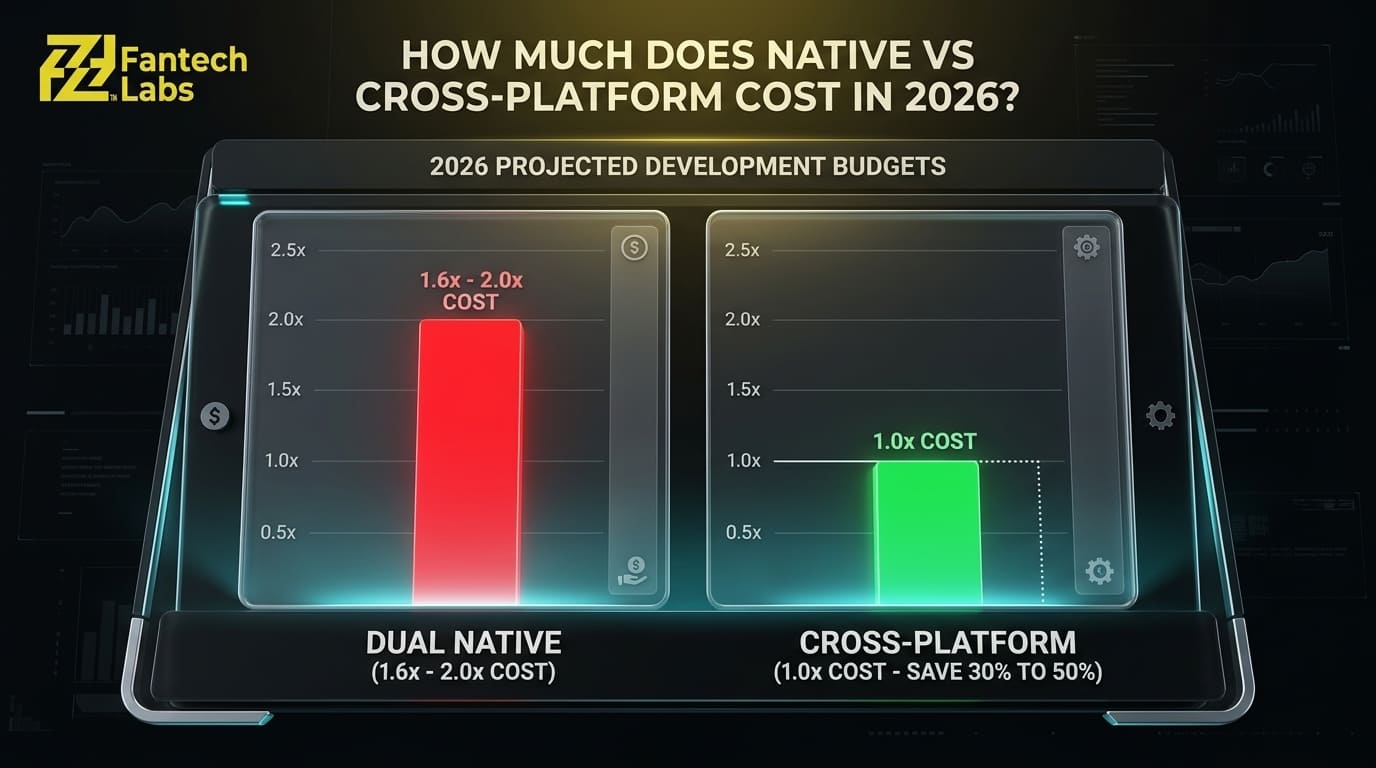
Cross-platform development using Flutter or React Native reduces costs by 30 to 50% compared to building two separate native apps. For a mid-market production build, that translates to roughly $80,000 to $250,000 for a cross-platform MVP versus $150,000 to $400,000 for a comparable dual-native build.
| Approach | Relative Cost | Initial Build Cost (Mid-Market) | Notes |
|---|---|---|---|
| Cross-platform (Flutter / React Native) | 1.0x baseline | $80,000 to $250,000 | One codebase, one team |
| Native iOS + Native Android | 1.6x to 2.0x | $150,000 to $400,000 | Two codebases, two pipelines |
| Hybrid (cross-platform + native modules) | 1.1x to 1.4x | $90,000 to $300,000 | Most enterprise apps |
| Native iOS only | 0.6x to 0.8x | $50,000 to $180,000 | Single platform only |
| Native Android only | 0.6x to 0.8x | $50,000 to $180,000 | Single platform only |
Flutter vs React Native vs Kotlin Multiplatform: How Do They Compare?
.jpeg)
What Is Flutter Best For?
Flutter is a Google-maintained framework that uses Dart and its own rendering engine to paint every UI pixel independently of the host platform's component library. This gives it pixel-perfect consistency across iOS, Android, web, and desktop from a single codebase.
Flutter is the best choice when your team is starting a new mobile product without an existing codebase. It works especially well when you need visually rich, animation-heavy UI with strict design consistency across platforms, or when you want to target iOS, Android, and web from one lean engineering team. Startups and scale-ups that need to move fast with limited resources tend to benefit the most from Flutter's single-codebase approach.
Real-world validation: Nubank achieved a 30% efficiency gain using Flutter for a fintech product that required rapid iteration across markets.
What Is React Native Best For?
React Native, maintained by Meta, renders using native platform components rather than its own engine. This means it inherits the visual conventions of each platform automatically. iOS buttons look like iOS buttons and Android cards look like Android cards without any extra configuration.
React Native is the best choice when your team has strong JavaScript and React experience. About 67% of developers already know JavaScript, making the hiring pool significantly larger than any other mobile framework. It is also the natural fit for content-driven apps like e-commerce, social, and news platforms, and for teams that share significant logic with an existing React web codebase.
Most JavaScript developers become productive in React Native within 1 to 2 months because React patterns transfer directly from web development. Expo's managed workflow eliminates the need for native module knowledge for most standard use cases.
What Is Kotlin Multiplatform Best For?
Kotlin Multiplatform (KMP) shares business logic across iOS and Android, including API layers, domain rules, validation, and caching, while keeping UI native on each platform. It is the fastest-growing of the three frameworks, jumping from 7% adoption in 2024 to 23% in 2025, a threefold increase in 18 months.
KMP is the best choice when native platform UI is non-negotiable for your product. It is particularly well-suited for teams that already have existing native Android investment and Kotlin experience, teams that want an incremental migration path rather than a full rewrite, and apps that require deep hardware integration where native UI has a structural advantage.
Real-world validation: Netflix, Google Workspace, and Cash App run KMP in production serving millions of daily users. Airbnb returned to shared code via KMP after previously abandoning React Native, and Duolingo shares 80% of its business logic across platforms using KMP while maintaining its simultaneous release cadence.
How Flutter, React Native, and KMP Differ
Flutter uses a custom renderer called Impeller and shares both UI and business logic across platforms using Dart. React Native uses native platform components and shares both UI and business logic using JavaScript or TypeScript. Kotlin Multiplatform shares only business logic while each platform retains its own native UI framework.
In terms of performance, Flutter achieves near-native speeds at 60 to 120fps with the Impeller engine. React Native reaches near-native performance through the New Architecture. KMP is structurally native because there is no rendering bridge at all.
Flutter supports iOS, Android, web, and desktop. React Native supports iOS, Android, and web. KMP supports iOS, Android, desktop, and server targets.
For cost, Flutter and React Native run at baseline 1.0x cost. KMP runs at approximately 1.3x because two separate UI codebases must be maintained, one in SwiftUI and one in Jetpack Compose.
Flutter is the fastest-growing framework in consumer app markets. React Native has the largest overall ecosystem and talent pool. KMP is the fastest-growing in enterprise adoption, having nearly tripled its market share in under two years.
When Does Native Development Still Win?
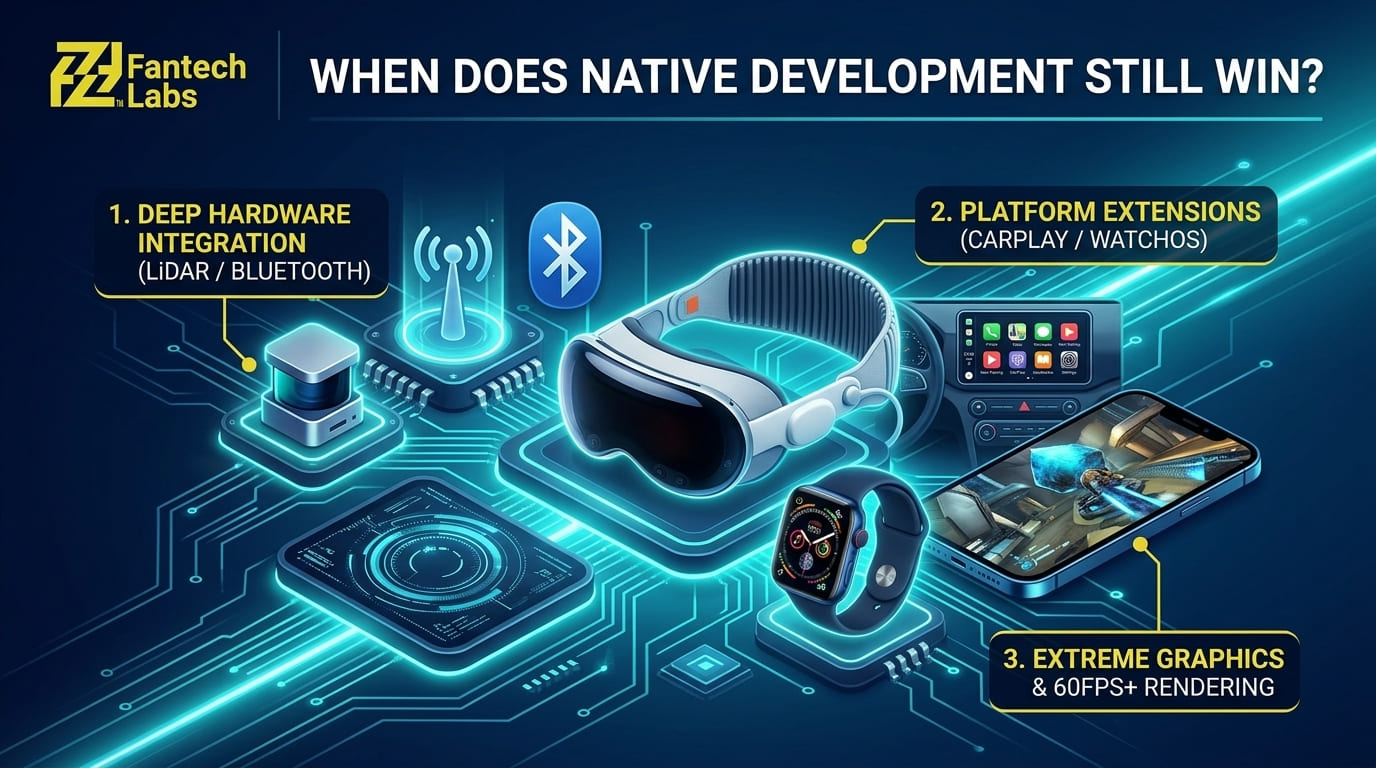
Cross-platform is the right default for most new mobile builds in 2026. Native development has a clear advantage in four specific scenarios.
Deep hardware integration is the clearest case for native. LiDAR scanning, Bluetooth peripherals, custom audio hardware, and AR/VR experiences that require full access to platform SDKs without abstraction layers are genuinely better served by native code.
Platform-extension targets also favor native. Apps that need to run on CarPlay, watchOS, tvOS, or Android Auto require platform-specific UI frameworks that cross-platform tools cannot fully replicate.
Extreme graphics workloads push toward native. Sustained 60fps-plus graphics-intensive applications including games and real-time video processing benefit from every possible reduction in rendering overhead.
Single-platform scope makes the native choice straightforward. If you are targeting only iOS or only Android, there is no shared-codebase advantage to unlock, and native development is the simpler path.
For everything else, including fintech apps, logistics platforms, healthcare tools, marketplaces, and internal enterprise tools, cross-platform delivers equivalent user experience at materially lower cost.
How Do You Choose the Right Framework in 2026?
Start With Your Team
The single most underweighted factor in framework selection is hiring pool size. A technically superior framework your team cannot staff 18 months from now is a worse choice than a slightly less optimal framework with abundant available talent.
If your team consists primarily of JavaScript and React developers, React Native is the natural starting point. If you are building a new mobile product with no existing codebase constraints, Flutter fits best. If your team has strong Kotlin and native Android experience and you are modernising an existing app, Kotlin Multiplatform is the right direction. Design-first teams targeting multiple platforms should default to Flutter. Enterprise teams where native UX is non-negotiable should evaluate KMP.
Start With Your Product
If team composition is flexible, the product requirements should drive the decision.
Content-driven apps in categories like e-commerce, news, and social fit React Native because the framework inherits native platform visual conventions automatically. Animation-heavy products with strict pixel-level design requirements fit Flutter because its custom rendering engine gives complete control over every visual element. Apps that need to share business logic while keeping native platform UI fit Kotlin Multiplatform. Teams targeting iOS, Android, and web simultaneously from one codebase have the most coherent story with Flutter. Teams migrating an existing native app incrementally should start with KMP. Apps built around AR, VR, LiDAR, or deep hardware integration should stay native.
The Hybrid Pattern
Discord, Shopify, and Microsoft Office mobile apps all use a hybrid pattern: cross-platform for the majority of the app, with native modules covering the specific features that require platform-level access. This approach captures most of the cross-platform cost savings while preserving native capability where it genuinely matters.
Frequently Asked Questions
Is Flutter or React Native faster in 2026?
Flutter and React Native deliver comparable performance for standard business applications in 2026. Flutter's Impeller engine achieves consistent 60 to 120fps for complex UIs, and React Native's New Architecture with Hermes V1 has eliminated the JavaScript bridge overhead that previously caused jank. The performance outcome for your app depends on what you build and how well it is built, not purely which framework you select.
How much does cross-platform development save compared to native in 2026?
Cross-platform development with Flutter or React Native reduces initial build cost by 30 to 50% compared to maintaining two separate native codebases. For a typical mid-market production app, that means saving $70,000 to $150,000 on the initial build. The savings grow larger over a 3-year horizon because cross-platform maintenance is materially cheaper since one codebase serves both platforms through one QA pipeline and one deployment workflow.
Is Kotlin Multiplatform ready for production in 2026?
Yes. Kotlin Multiplatform is production-ready and in active use at Netflix, Google Workspace, Cash App, and Duolingo, which shares 80% of its business logic across platforms via KMP. Its adoption grew from 7% to 23% between 2024 and 2025, and JetBrains continues to expand its tooling and ecosystem support.
Should a startup use native or cross-platform in 2026?
For most startups, cross-platform with Flutter or React Native is the correct starting point. It cuts budget by 30 to 50%, reaches both iOS and Android simultaneously, and allows a lean team to move fast. Startups should choose native only if their core product depends on deep hardware integration or platform-specific UX that cross-platform cannot replicate at the performance level required.
What is the difference between Flutter and Kotlin Multiplatform?
Flutter shares both UI and business logic across platforms using Dart and a custom rendering engine. Kotlin Multiplatform shares only business logic, including API calls, data models, and domain rules, while each platform uses its own native UI framework: SwiftUI on iOS and Jetpack Compose on Android. Flutter is generally faster to build because one UI codebase serves all platforms. KMP produces native-feeling UIs with no rendering abstraction because the UI is genuinely native on each platform.
Summary: Which Should You Choose?
The right choice in 2026 depends on three factors in order of priority: your team's existing skills, your product's UI and integration requirements, and your timeline and budget.
Cross-platform with Flutter or React Native is the right default for roughly 80% of new commercial mobile apps. It delivers near-native performance, cuts costs by 30 to 50%, and reaches both platforms simultaneously from one team. Kotlin Multiplatform is the right choice when native UI fidelity is non-negotiable, and your team has Kotlin experience. Pure native development wins only for deep hardware integration, platform-extension targets, or single-platform scope.
The binary native-vs-cross-platform debate is outdated. In 2026, the real question is which cross-platform framework or which hybrid approach fits your specific team, product, and growth stage.
Author Bio
Tayab Ali | Senior Mobile App Developer Tayab Ali is a Senior Developer at Fantech Labs with over 8 years of experience specializing in cross-platform mobile architecture. He helps startups and enterprises evaluate Flutter, React Native, and Native frameworks to build high-performance, scalable applications. His technical approach ensures businesses optimize their development budgets without sacrificing UI quality or long-term maintainability.