_Zdgpci.webp)
Key Takeaways
- Custom web development in Canada costs between $3,500 and $150,000 CAD depending on scope, with most small business sites landing between $3,500 and $12,000.
- Canadian businesses pay 23 to 41% more than equivalent U.S. quotes due to CAD/USD pricing on international platforms and software licences.
- In 2026, a business website is no longer a marketing brochure. It is an operational platform that captures leads, processes payments, connects to CRM and ERP systems, and feeds analytics pipelines.
- Template builds typically require a full rebuild within two to three years, making their long-term cost higher than a proper custom build from the start.
- Canada's e-commerce market is projected to grow from USD $41.79 billion in 2025 to USD $66.89 billion by 2030 at a 9.86% annual growth rate.
- Google Core Web Vitals scores are a direct ranking signal. A site that loads in under 1.2 seconds will outrank a slower competitor for the same search query, all else being equal.
- Working with a Canadian team means pricing in CAD, availability during Canadian business hours, and familiarity with CASL, .ca domains, and Quebec French requirements.
Why Canadian Businesses Are Rethinking Their Websites in 2026
For years, building a website meant choosing a theme, installing a few plugins, and publishing content. That approach worked when websites primarily served as marketing brochures. In 2026, that assumption no longer holds.
Today, a business website is often the center of digital operations. It captures leads, processes payments, connects to CRM and ERP systems, manages user accounts, delivers dashboards, and feeds analytics pipelines. When those responsibilities grow, the limitations of templates and rigid platforms become visible quickly.
This is the main reason Canadian businesses are investing in custom web development services at a growing rate. The goal is not simply a unique design. The goal is building a platform that supports business workflows, integrates with critical systems, and scales without breaking as complexity increases.
Canada's e-commerce market is projected to grow from USD $41.79 billion in 2025 to USD $66.89 billion by 2030 at a 9.86% compound annual growth rate. Businesses that enter that market on a slow, templated platform are competing at a structural disadvantage against those whose sites load faster, rank higher, and convert better.
What Is Custom Web Development and What Makes It Different?
Custom web development means building a website or web application designed specifically for your business requirements, rather than adapting a pre-built theme or template. A custom-built site is engineered from the ground up with your specific users, workflows, and growth objectives in mind.
The practical difference between a custom build and a template build shows up in three places:
Performance is the first. Template builds carry unused code from features you never enabled. Every theme comes with CSS, JavaScript, and plugin overhead that slows page load times regardless of your content. A custom build contains only what your site actually needs, which makes it significantly faster and easier to optimize for Core Web Vitals.
Scalability is the second. A custom build is designed for your anticipated growth. When your traffic doubles or your product catalog expands by a factor of ten, the underlying structure was designed to handle it. A template site typically hits a ceiling that requires a full rebuild, and that rebuild usually costs more than a proper custom build would have cost in the first place.
Integration is the third. A custom build can connect directly to your CRM, ERP, inventory system, booking platform, or any other tool your business already runs. Template sites connect to external tools through plugins that add latency, introduce security risk, and break with every platform update.
How Much Does Custom Web Development Cost in Canada in 2026?
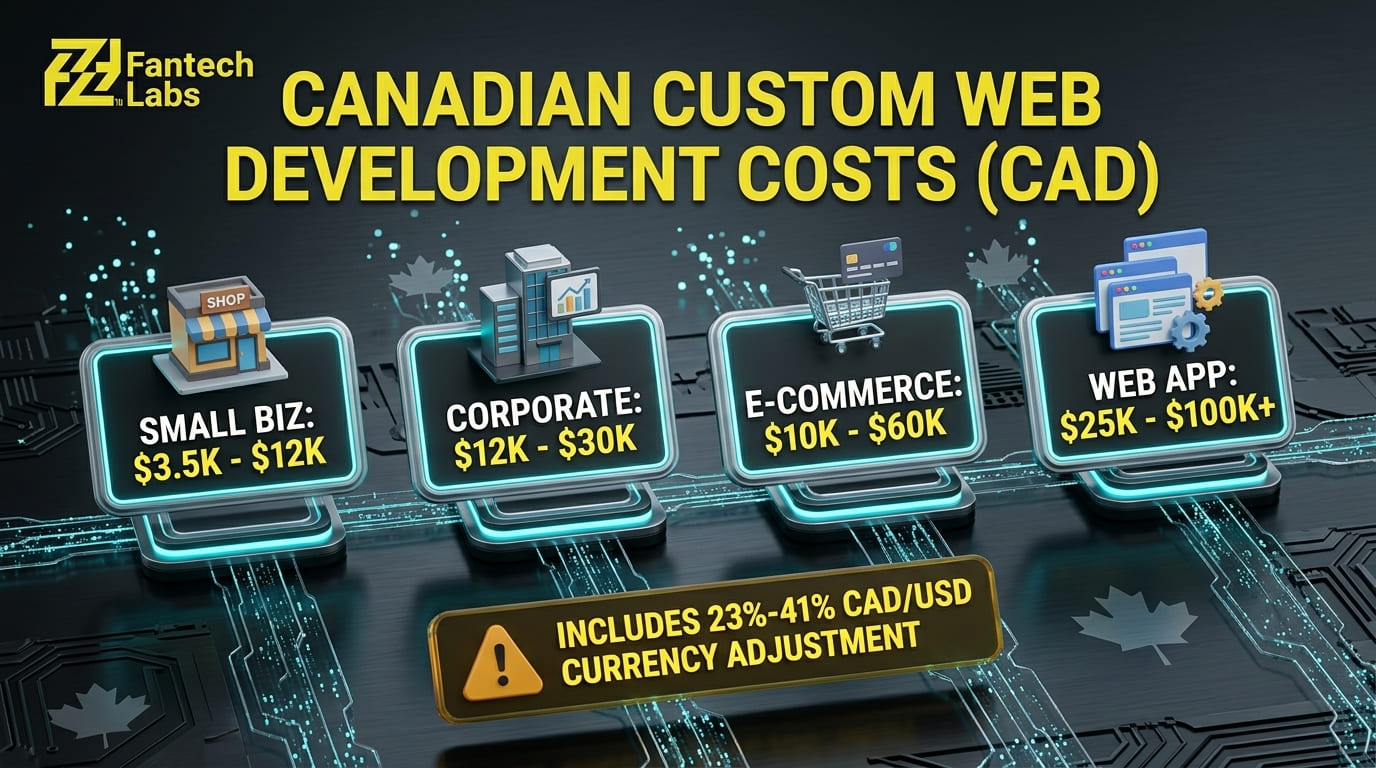
Custom web development in Canada ranges from $3,500 to $150,000 CAD depending on scope, complexity, and the team you hire. Here is how the investment breaks down across typical project types:
| Project Type | What Is Included | Typical CAD Range (2026) |
|---|---|---|
| Small business website | 5 to 15 pages, CMS, contact forms, local SEO | $3,500 to $12,000 |
| Corporate or professional services site | Multi-section, blog, case studies, lead capture | $12,000 to $30,000 |
| Custom e-commerce store | Shopify or Magento, checkout optimization, inventory sync | $10,000 to $60,000 |
| Web application | Custom logic, user portals, API integrations | $25,000 to $100,000+ |
| Enterprise platform | Multi-location, ERP/CRM integration, headless CMS | $50,000 to $150,000+ |
One pricing reality that most guides aimed at Canadian buyers miss: Canadian businesses typically pay 23 to 41% more than equivalent U.S. quotes because of CAD/USD pricing on international software licences, hosting platforms, and cloud services. A Shopify plan priced in USD, a domain registered on a U.S. registrar, and AWS hosting billed in USD all carry an implicit currency cost that never appears in the headline project number.
Hidden costs including content creation, SEO setup, hosting, and monthly maintenance can add 20 to 40% to the base project fee. Requesting an itemized proposal that separates design, development, content, and SEO into individual line items is the single most important step you can take before signing any development contract.
How Long Does a Custom Web Development Project Take in Canada?
Timeline depends almost entirely on project complexity and how quickly the client provides content, branding assets, and feedback. Delays on the client side are the most common reason web projects extend beyond the initial estimate.
| Project Type | Typical Timeline |
|---|---|
| Small business website (5 to 15 pages) | 4 to 8 weeks |
| Corporate or professional services site | 8 to 14 weeks |
| Custom e-commerce store | 8 to 16 weeks |
| Web application with custom logic and APIs | 3 to 6 months |
| Enterprise platform with ERP/CRM integration | 6 to 12 months |
Anyone promising a fully custom 30-page website in 10 days is either using a heavy template or planning to skip QA. Realistic timelines from established Canadian teams include time for discovery, design review cycles, development, QA testing across devices and browsers, and a pre-launch period to resolve issues before going live.
What Technologies Do Canadian Web Development Teams Use in 2026?
Technology choices shape long-term performance, maintenance cost, and integration capability. Here is what the current Canadian web development landscape looks like:
| Layer | Common Technologies | Notes |
|---|---|---|
| Frontend frameworks | Next.js, React, Gatsby, Astro | Next.js dominates for performance and SEO |
| Languages | JavaScript, TypeScript | TypeScript increasingly standard for maintainability |
| E-commerce platforms | Shopify, Magento, WooCommerce | Shopify suits most SMEs; Magento for complex catalogs |
| CMS platforms | WordPress, Strapi, Sanity | Headless CMS growing fast for performance-sensitive builds |
| Backend and APIs | Node.js, REST APIs, GraphQL | Depends on integration requirements |
| Hosting and CDN | Vercel, Netlify, AWS, Cloudflare | Canadian-based or CDN-enabled hosting important for local performance |
| Performance targets | Core Web Vitals, LCP under 1.2s, INP | Google ranking signal as of 2024, now table stakes |
Canadian-based or CDN-enabled managed hosting is worth the additional $30 to $80 per month over cheap shared hosting because slow load times for Canadian visitors directly affect Google rankings. Businesses on cheap shared hosting in the United States consistently see worse search performance for Canadian-targeted queries than those on infrastructure optimized for Canadian traffic patterns.
What Are Core Web Vitals and Why Does It Matter for Canadian Businesses?
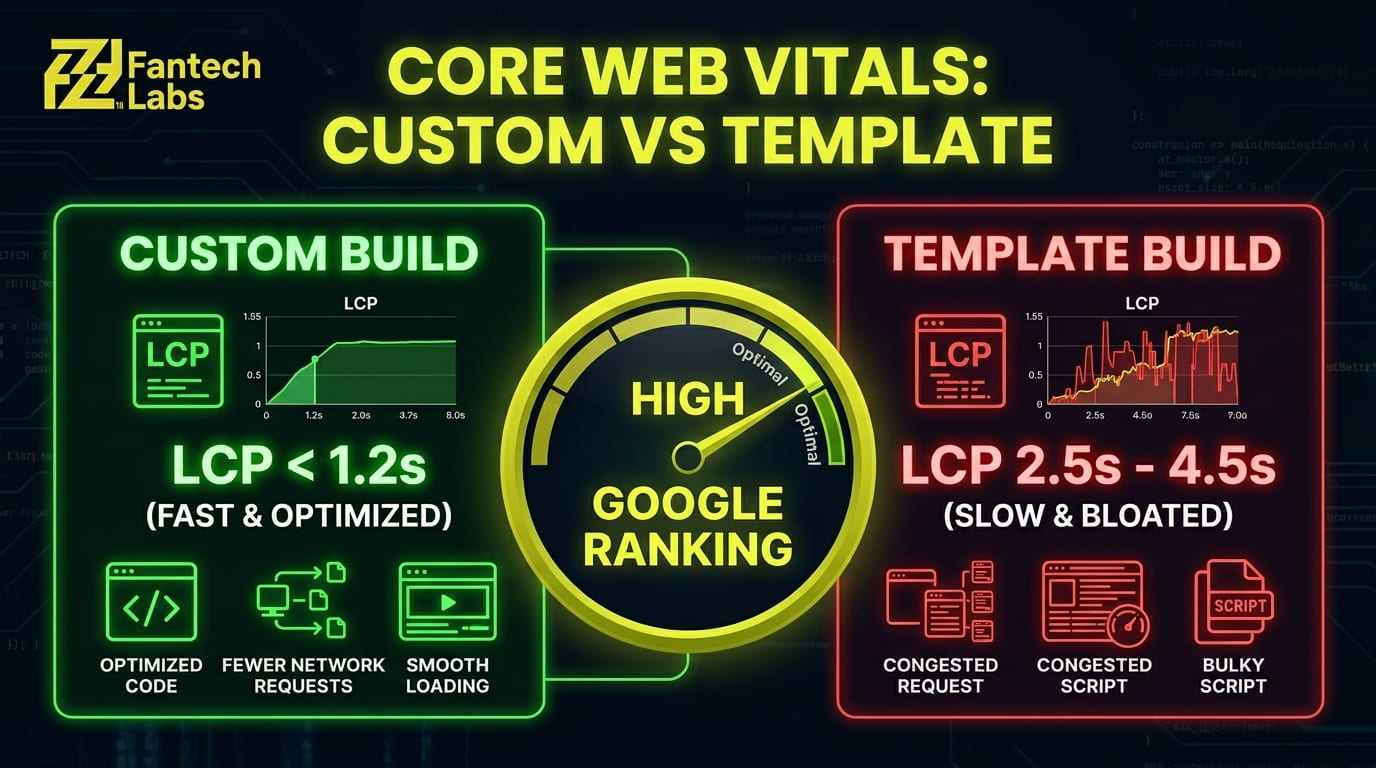
Core Web Vitals are the performance metrics Google uses as a direct ranking signal when deciding which pages to show for a given search query. The three metrics are Largest Contentful Paint (LCP), which measures how fast the main content loads; Interaction to Next Paint (INP), which measures how quickly the page responds to user input; and Cumulative Layout Shift (CLS), which measures visual stability as the page renders.
A site with poor Core Web Vitals scores will rank below a faster, more stable competitor for the same search query, all else being equal. This is not a future consideration. It has been a confirmed Google ranking factor since 2024, and its weight in the algorithm has continued to increase.
A properly built custom site targets LCP under 1.2 seconds. Most template-based builds running standard page builders and plugin stacks land in the 2.5 to 4.5 second range, which Google classifies as "needs improvement" or "poor." The gap between those benchmarks is measurable in search rankings and in conversion rates. Research consistently shows that a one-second improvement in page load time increases conversions by 2 to 7% for e-commerce sites.
What Are the Key Trends Shaping Custom Web Development in Canada in 2026?
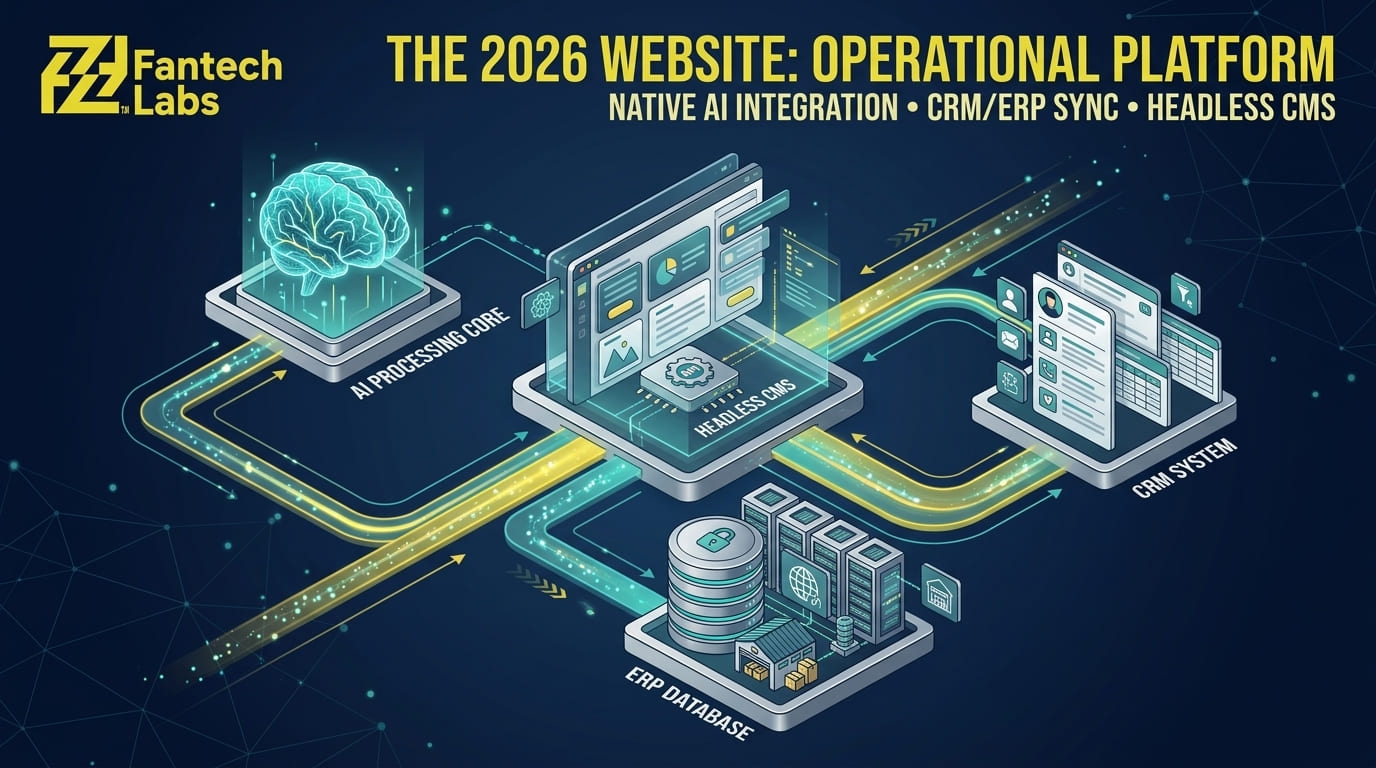
AI integration is becoming a baseline expectation. AI tools are being integrated directly into websites to recommend services, personalize content, and automate customer interactions. Custom development gives full control over how AI is used and how data flows between the website and business systems. Template platforms that offer AI add-ons apply those features generically, without the ability to tailor them to your specific workflows.
Headless CMS architecture is growing fast. In a headless CMS setup, the content management layer is fully separated from the frontend presentation layer. This means editors can update content without developer involvement while the frontend can be built on the fastest possible framework without being constrained by what the CMS can render. Strapi and Sanity are gaining ground on WordPress for this reason, particularly for businesses that prioritize performance.
Interactive and dynamic elements are replacing static pages. Users in 2026 expect scroll-triggered animations, personalized dashboards, interactive calculators, and real-time data displays. Custom development gives full control over these features without slowing down the website. When built properly, interactive elements improve session duration, lead generation, and conversions. When bolted onto a template through plugins, they typically do the opposite.
Full ownership of code and infrastructure is a growing priority. Businesses are choosing custom websites because they want control over their digital assets. Templates lock companies into themes and subscription plans that can be changed or discontinued by the vendor. Custom development gives full ownership of the code, database, and hosting from day one.
Custom Website vs Template: The Real Long-Term Cost Comparison
The template option looks cheaper at the start. It is. The question is what the total cost looks like over five years, not at launch.
| Cost Factor | Template Build | Custom Build |
|---|---|---|
| Initial build cost | $500 to $5,000 | $5,000 to $150,000+ |
| Time to launch | Days to weeks | Weeks to months |
| Performance (Core Web Vitals) | Usually poor to needs improvement | Optimized from the start |
| Rebuild needed within 3 years | Very common | Rarely |
| Integration with CRM/ERP | Plugin-dependent, fragile | Native, reliable |
| Long-term maintenance cost | Grows with plugin stack | Predictable |
| Total 5-year cost (SME) | Often $15,000 to $40,000 | Often $12,000 to $35,000 |
Most Canadian businesses in competitive markets who start with a template end up paying more in total over five years than if they had started with a proper custom build. The rebuild cost, the lost revenue from poor search rankings, and the accumulated cost of plugin subscriptions and compatibility fixes compound over time in ways that are not obvious at the point of the initial decision.
What to Look for When Choosing a Custom Web Development Partner in Canada
Choosing a web development partner is a decision with a 3 to 5-year horizon. The right partner does more than deliver a finished build on a deadline.
A development partner worth hiring gives you an itemized proposal that separates design, development, content, and SEO into individual line items. They explain their technology choices in plain language and tell you why a given stack fits your specific project rather than defaulting to whatever they built last. They have a defined QA process and can show you how they test performance, mobile usability, and cross-browser compatibility before handing over a finished site. And they are clear about what ongoing support looks like after launch, because every website requires maintenance, and the team that built it is the fastest path to resolving issues when they arise.
For Canadian businesses specifically, working with a Canadian team means pricing in CAD without hidden currency conversions, availability during Canadian business hours, and familiarity with CASL compliance for email capture, .ca domain management, and French language requirements for Quebec-facing content.
Frequently Asked Questions
What is custom web development and why do Canadian businesses need it in 2026?
Custom web development is the process of building a website or web application designed from scratch for a specific business, rather than using a pre-built theme or template. Canadian businesses need it in 2026 because websites have evolved from marketing brochures into operational platforms that connect to CRM and ERP systems, process payments, manage user accounts, and feed analytics pipelines. Template builds cannot support that level of integration reliably, and their performance limitations directly affect Google rankings and conversion rates.
How much should a Canadian business budget for a custom website in 2026?
A professionally built small business website in Canada costs between $3,500 and $12,000 CAD. Custom e-commerce stores start at approximately $10,000 and can exceed $60,000 for complex functionality. Web applications with custom back-end logic and API integrations typically cost $25,000 to $100,000 or more. Budget an additional 20 to 40% of the base project fee for content creation, SEO setup, hosting, and ongoing monthly maintenance, which typically runs $75 to $300 per month.
How is a Canadian web development agency different from an offshore team?
A Canadian web development agency prices in CAD, is available during Canadian business hours, and is familiar with Canadian compliance requirements including CASL, .ca domain management, and Quebec French content requirements. Offshore teams can deliver technically sound code at lower hourly rates but commonly create communication delays, time zone friction, and gaps in Canadian market knowledge that show up in the finished product. For businesses that need ongoing integration between their website and Canadian business systems, local accountability matters significantly after launch.
What is the difference between a headless CMS and a traditional CMS for Canadian businesses?
A traditional CMS like WordPress manages both the content and how it is displayed on the frontend. A headless CMS like Strapi or Sanity manages only the content, while the frontend is built separately on a high-performance framework like Next.js. The headless approach allows editors to update content without developer involvement while giving developers full control over frontend performance. For Canadian businesses prioritizing Core Web Vitals scores and fast page loads, headless CMS architecture consistently outperforms traditional CMS setups on the same infrastructure.
Is web development still worth investing in when AI tools can build websites automatically?
Yes. In 2026, web development is still in strong demand even with the expansion of AI-assisted development tools. AI tools help developers work faster, but they cannot replace expertise in system architecture, custom integration, performance optimization, and problem-solving for complex business requirements. AI-generated websites built without a developer's oversight consistently underperform on Core Web Vitals, lack proper schema markup, and fail to integrate reliably with the business systems they need to connect to. The businesses benefiting most from AI in web development are those working with experienced development teams that use AI to accelerate work, not replace the engineering judgment behind it.
About Fantech Labs: Fantech Labs is a Calgary-based IT and web development company serving businesses across Canada. We build custom websites, web applications, AI automations, and system integrations for businesses that need technology to work the way their operations actually run.
Talk to our web development team
About the Author
Written by Hassan Nasir, Lead Full-Stack Developer & Technical Strategist at Fantech Labs. Hassan engineers high-performance custom web and mobile applications that actually drive business growth, rather than just looking good on a screen. With deep expertise in scalable architecture, API integrations, and modern frameworks, he helps Canadian enterprises cut through technical debt and build robust digital platforms that scale efficiently.