Key Takeaways
- 43% of startups fail because no market need existed for their product, according to CB Insights post-mortem analysis. An MVP tests whether that need exists before the full budget is committed.
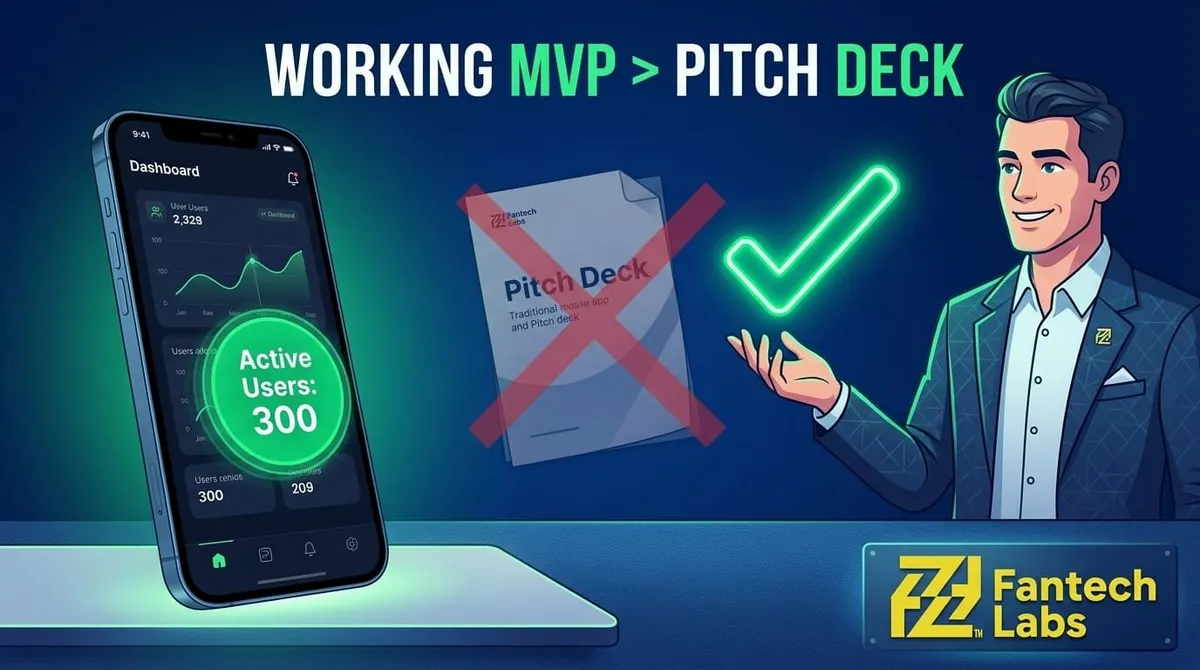
- Investors in 2026 want a working product with real usage data and early revenue signals, not a pitch deck or a static prototype. A live app with retention data is fundable. A pitch deck is not.
- A properly scoped mobile app MVP takes 10 to 14 weeks and costs CAD $25,000 to $65,000 in Canada. If your MVP takes more than 14 weeks, you are building too many features.
- Flutter is the best framework for Canadian MVPs in 2026. One codebase delivers iOS and Android, cutting development time by 30 to 40% compared to building native apps separately.
- Canadian startups can recover up to 80% of MVP development costs through SR&ED tax credits and IRAP funding. Most founders miss this entirely.
- Fantech Labs builds investor-ready Flutter MVPs for Canadian startups. Book a free consultation at fantechlabs.ca/contact-us.
What is a mobile app MVP and how does it attract investors in 2026?
A mobile app MVP, or Minimum Viable Product, is the simplest working version of your app that solves one core problem for a specific group of users. It is not a half-finished app. It is a deliberately scoped, launch-ready product that tests your core hypothesis with real users before you invest in full-scale development. In 2026, investors strongly prefer traction data over slide decks. A working MVP with real activation rates, retention data, and early revenue signals is the strongest fundraising asset a founder can bring to any investor meeting.
WHY AN MVP IS THE ONLY RATIONAL STARTING POINT IN 2026
Every week without validated learning is a runway spent on assumptions. Most founders build what they think users want, ship after 12 months of development, and discover the market does not care. An MVP surfaces real user behavior before the team locks into a full architecture.
The numbers are clear. CB Insights analyzed startup post-mortems and found 43% of startups fail because no market need existed for their product. Investor expectations have also fundamentally changed. In 2026, with funding rounds harder to close, investors want to see a working product with real usage data and ideally early revenue signals not a pitch deck or static prototype.
The MVP is not just a development strategy. It is a risk management tool that protects your runway, generates the evidence investors actually need, and tells you whether to iterate, pivot, or stop before the budget is exhausted.
What an MVP Is Not
An MVP is not a full product with features removed. It is not a cheap or unfinished version of your product. It is not a prototype that only shows how the app could look. Teams that frame it as a "lite version" overshoot scope while losing the clarity that makes feedback useful.
An MVP is a focused experiment around one hypothesis. It includes only the features a user needs to complete the core action. Everything outside the primary journey belongs in the backlog.
How Successful Companies Started With MVPs
Consider how successful companies started. Instagram's MVP only allowed users to post photos, add filters, and share them. No stories, no reels, no DMs. Uber's MVP was a basic ride-hailing app with a small fleet in San Francisco requesting a ride, seeing the driver on a map, pay automatically. WhatsApp launched with only instant messaging. Airbnb started as a website where two people rented air mattresses in their apartment.
Each of these MVPs answered one question: do real people use this and come back?
THE INVESTOR-READY MVP: WHAT FUNDRAISING LOOKS LIKE IN 2026
Investors evaluate one thing above all others: whether real people use the product and return. Not the idea. Not the team deck. Not the market size slide. The data.
The Metrics Investors Actually Ask About
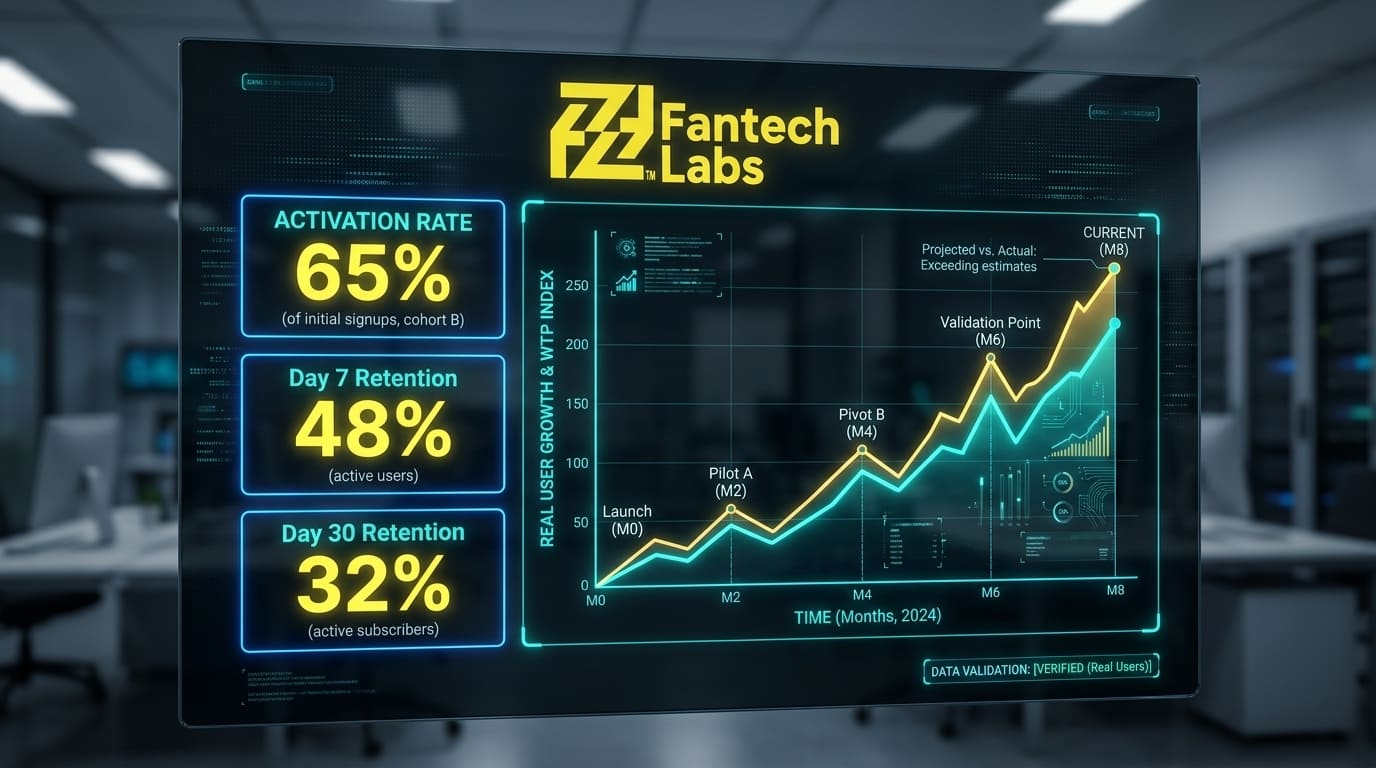
The metrics investors specifically ask about in 2026 are:
- Activation rate - what percentage of sign-ups complete the core action
- Day 7 retention - are users coming back a week after signing up
- Day 30 retention - are they still there a month later
- Willingness to pay - are users converting from free to paid
A waitlist of 5,000 emails does not answer any of these questions. A working app with 300 active users and a 40% Day 30 retention rate answers all of them.
Why MVP Discipline Signals Investor Confidence
Building an MVP first also demonstrates capital discipline to investors. A founder who launched, tested, and iterated on a focused product before asking for Series A funding signals the exact judgment investors want to back. Investor expectations have changed — in 2026, they want to see a working product with real usage data and ideally early revenue signals, not just a pitch deck or a static prototype.
HOW TO SCOPE A MOBILE APP MVP CORRECTLY
The most expensive mistake in MVP development is building too much. Feature creep is driven by internal anxiety, not user evidence. Every extra feature adds cost, expands the bug surface, extends the timeline, and overwhelms a first-time user.
Define Your Single Riskiest Assumption
Start by identifying your single riskiest assumption. Not your five riskiest assumptions. One. What is the hypothesis that, if proven wrong, makes your entire business model invalid? Build only what is needed to test that hypothesis.
Map the Minimum User Journey
Map the minimum user journey that tests your core hypothesis. What is the single primary action your user must complete? Every screen that serves that action belongs in the MVP. Everything else belongs in a numbered backlog for future sprints.
A practical rule: if a feature cannot be measured against your core outcome metric, it does not belong in this build.
Talk to Users Before Writing Code
Talk to at least 10 to 20 target users before writing any code. Five representative users before launch will surface more real friction than 100 internal test sessions. Internal testing produces false confidence. Launching without event tracking means no behavioral data post-launch — and this cannot be corrected retroactively.
THE RIGHT TECH STACK FOR A CANADIAN MVP IN 2026
Your technology choice affects budget, launch speed, and scalability. In 2026, the best stack for most Canadian MVPs is Flutter for mobile, a modular REST API for the backend, and AWS Canada or Firebase for hosting.
Why Flutter Is the Best Choice for Canadian MVPs
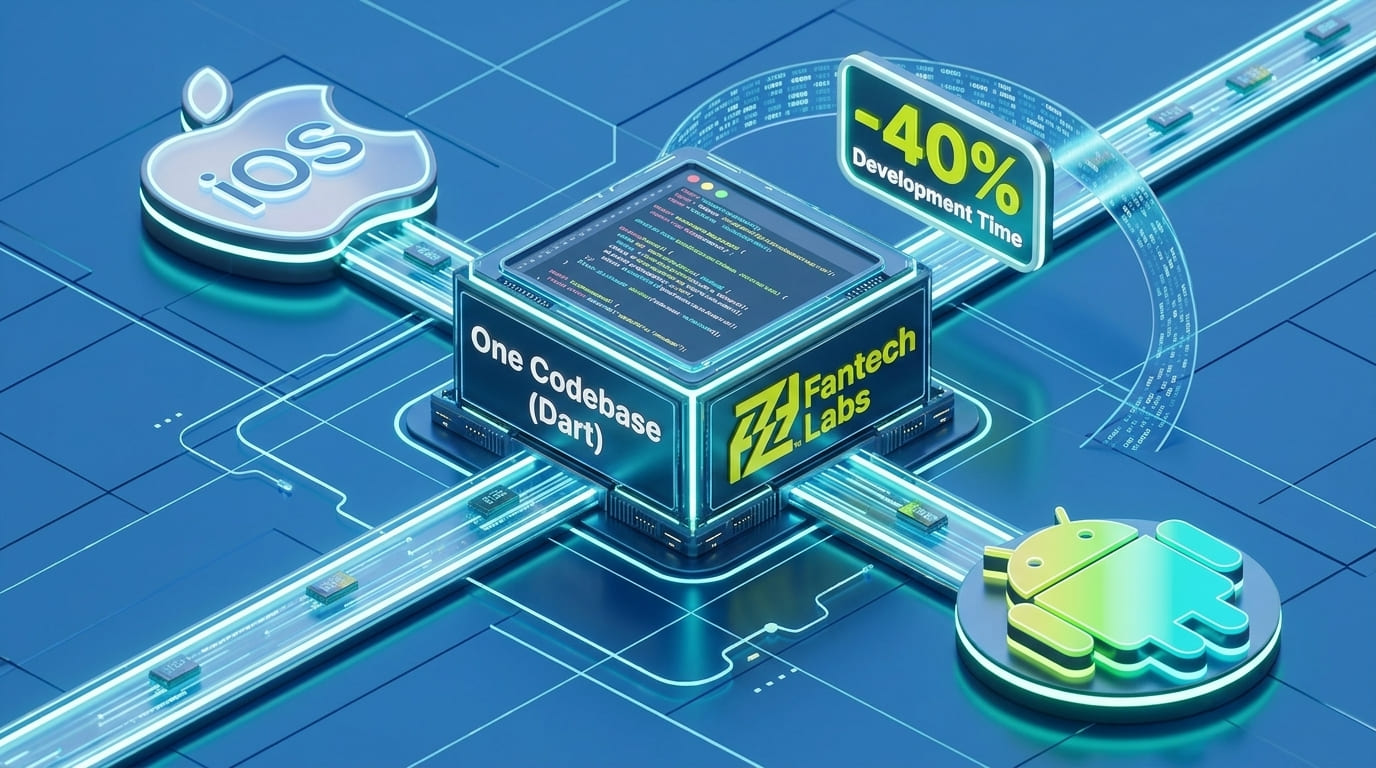
Flutter is the clear choice for Canadian mobile MVPs for four reasons.
First, a single codebase delivers both iOS and Android, cutting development cost by 30 to 40% compared to building separate native apps. Second, hot reload enables developers to see changes instantly, dramatically speeding iteration cycles. Third, bilingual support for English and French is clean and straightforward, which matters for any Canadian startup targeting a national market. Fourth, Flutter's performance with the Impeller engine achieves 58 to 60 FPS on complex UIs, close to native performance for the vast majority of business app use cases.
Fantech Labs has been building Flutter MVPs for Canadian clients since 2019. View our case studies at fantechlabs.ca/casestudies.
React Native as an Alternative
React Native is a valid alternative when your founding team already has strong JavaScript expertise and the MVP scope does not justify a framework transition. React Native also excels when your app needs to feel authentically native on each platform or when you need access to a specific third-party library that only has a well-maintained JavaScript SDK.
Backend and Infrastructure
For the backend, use a modular REST or GraphQL API from day one. A monolithic backend saves days in the MVP stage and costs weeks at the growth stage when you need to scale or add features. Never build a throwaway architecture unless you explicitly plan for a throwaway prototype.
Install Sentry or Firebase Crashlytics before the first external user opens your app. Early adopters forgive limited features but they do not forgive crashes.
THE CANADIAN MVP FUNDING ADVANTAGE MOST FOUNDERS MISS
Canadian startups building mobile app MVPs have access to government funding programs that can recover a significant portion of development costs. Most founders are entirely unaware of these programs.
SR&ED Tax Credits
The SR&ED, or Scientific Research and Experimental Development, program allows Canadian businesses to recover 35% or more of qualifying R&D expenditures as a tax credit. Software development that involves technological advancement solving a technical challenge that was not straightforwardly solved using existing knowledge qualifies. Most properly scoped MVPs qualify for SR&ED. A CAD $75,000 MVP could generate $25,000 or more in SR&ED credits.
IRAP Funding
The IRAP program through NRC provides direct funding to innovative Canadian SMBs for technical R&D projects. Funding can cover 50 to 80% of eligible costs depending on the project scope and organization profile.
Combining Both Programs
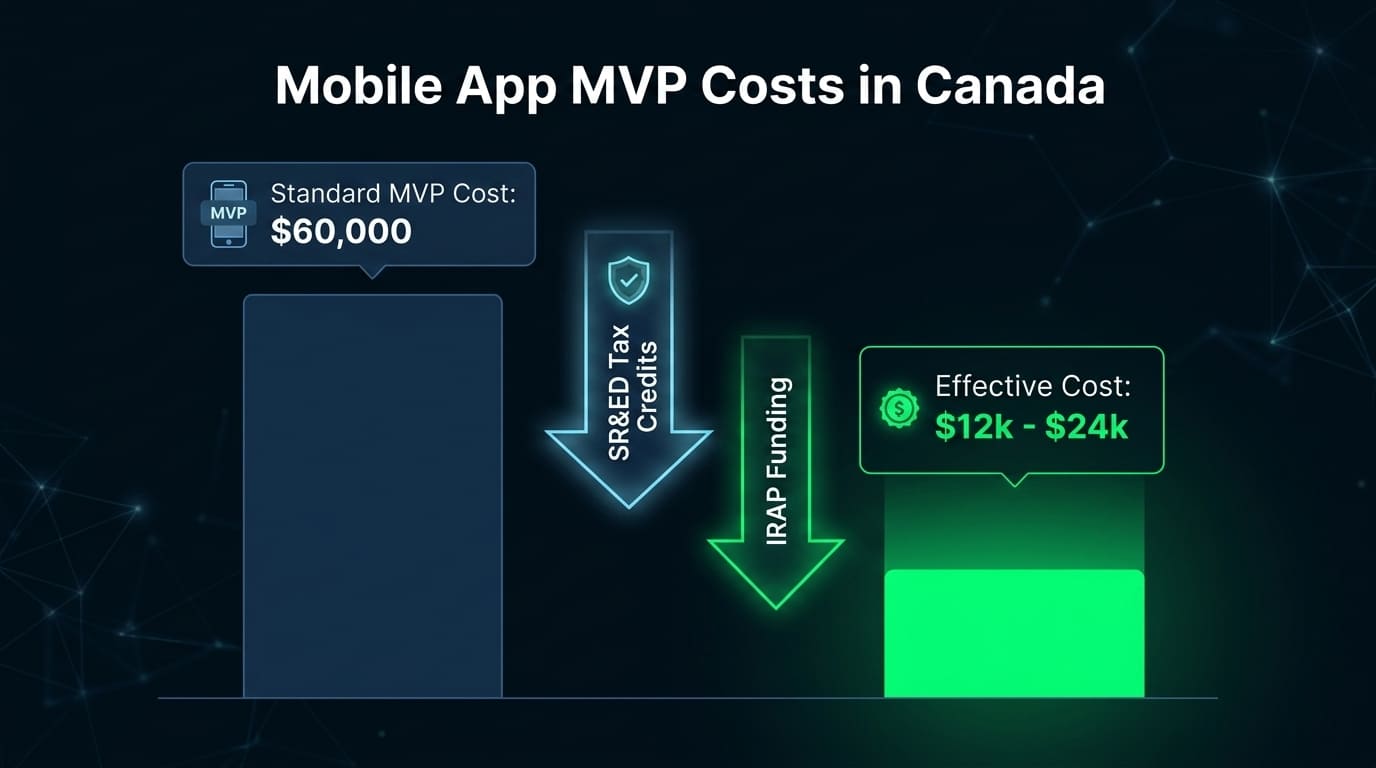
SR&ED and IRAP can in some cases be combined, recovering up to 80% of MVP development costs. This changes the economics of a Canadian MVP significantly. A CAD $60,000 MVP can effectively cost CAD $12,000 to $24,000 after government support.
Fantech Labs can advise on structuring your MVP project to maximize SR&ED eligibility. Consult a qualified SR&ED specialist for formal assessments specific to your situation.
PIPEDA COMPLIANCE IN CANADIAN MVPS
If your MVP collects any personal information from Canadian users — which includes names, email addresses, health data, and financial information — PIPEDA applies from your very first user. This is not optional and cannot be retrofitted cheaply after launch.
What PIPEDA Requires in an MVP
The practical requirements for a PIPEDA-compliant MVP are:
- Explicit informed consent before collecting any personal data
- Clear purpose limitation so data collected for one reason is not used for another
- A privacy policy that is accessible within the app
- A mechanism for users to request data deletion
- Encrypted storage for all personal information
Retrofitting compliance architecture after launch is always more expensive than building it in from the start. Fantech Labs builds PIPEDA compliance into every MVP from the architecture stage, not as an afterthought.
HOW LONG DOES AN MVP TAKE AND WHAT DOES IT COST IN CANADA?
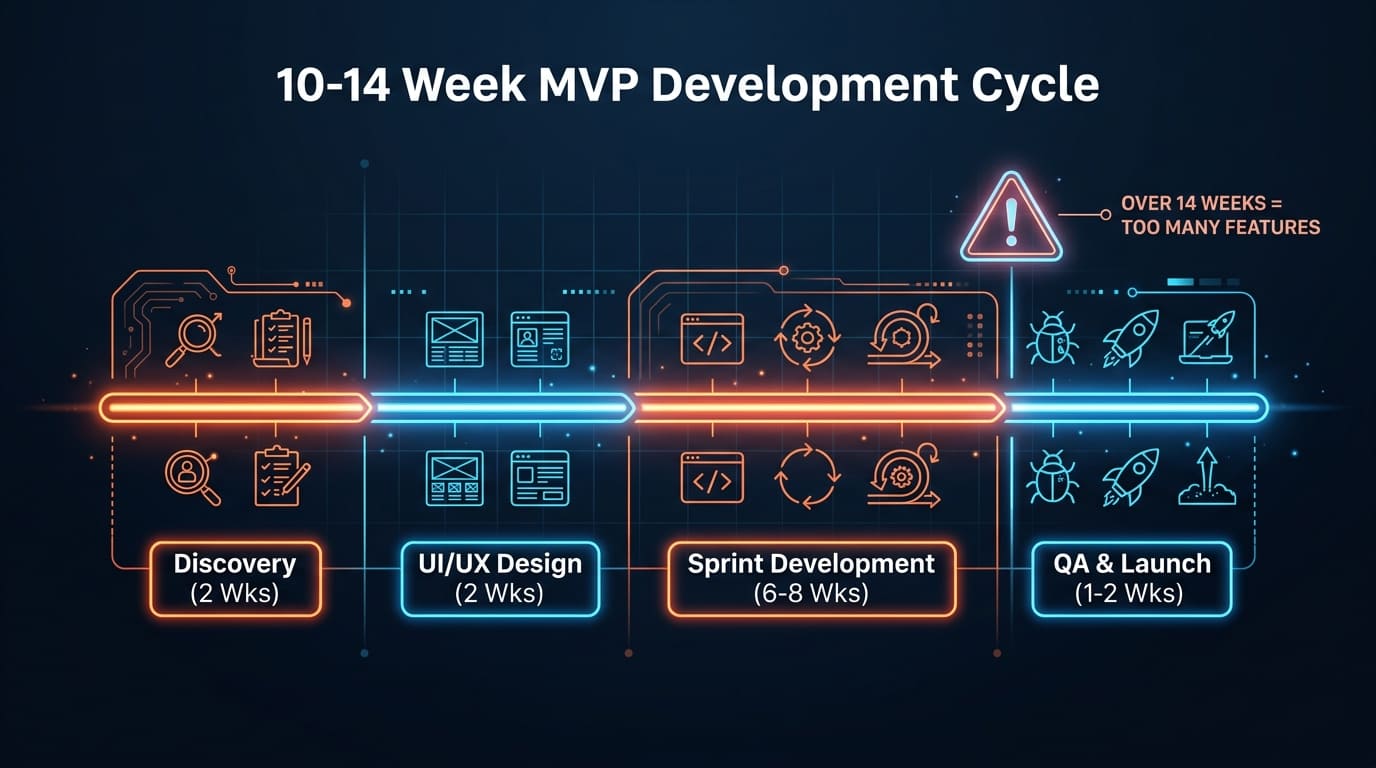
A properly scoped mobile app MVP in Canada takes 10 to 14 weeks from discovery to launch. If your MVP development is taking more than 14 weeks, you are building too many features.
Timeline Breakdown
The timeline breaks down as follows:
- Discovery and requirements: 2 weeks
- UI and UX design: 2 weeks
- Development in two-week sprints: 6 to 8 weeks
- Quality assurance and launch preparation: 1 to 2 weeks
Cost Breakdown
A simple MVP with 3 to 5 core features on a single platform costs CAD $25,000 to $50,000. A standard cross-platform MVP using Flutter for both iOS and Android with a backend and basic integrations costs CAD $50,000 to $90,000. An MVP with AI features, PIPEDA compliance requirements, or complex third-party integrations starts at CAD $75,000.
Canadian development teams charge CAD $100 to $180 per hour for senior developers. This reflects PIPEDA expertise, time zone alignment, clear communication, and the legal accountability that comes with a Canadian contract.
Before factoring in SR&ED and IRAP, a CAD $60,000 MVP is a significant investment. After government support, the effective cost can drop to CAD $12,000 to $24,000.
WHAT HAPPENS AFTER YOUR MVP LAUNCHES
An MVP is not finished at launch. It has started. Define your success metrics before you build, measure them after you launch, and let the data drive your next decision.
The Three Decisions MVP Data Produces
After analyzing your post-launch data, you will make one of three decisions.
Iterate - demand exists for what you built, users are returning, and the data supports continuing to improve and expand the product.
Pivot - demand exists but not for what you built. Users are signing up but not completing the core action you expected. Reframe the product around what users actually do in your app.
Stop - no activation, no retention, no willingness to pay. The MVP saved you from spending CAD $300,000 building the wrong thing. Fail fast and move to the next idea.
Each of these outcomes is a success. The MVP's job is to generate learning before the full budget is committed.
COMPARE OPTIONS WITH FANTECH LABS
Step 1: Book a free 30-minute consultation at fantechlabs.ca/contact-us and describe your app idea.
Step 2: We run a structured discovery session to define your core hypothesis and minimum viable scope.
Step 3: A formal discovery phase produces wireframes, a technical specification, and a validated cost estimate.
Step 4: Development proceeds in two-week sprints with working software delivered at each milestone.
Step 5: We assist with App Store and Google Play submission and post-launch analytics setup.
Frequently Asked Questions
How much does mobile app MVP development cost in Canada?
A simple MVP costs CAD $25,000 to $50,000. A standard cross-platform MVP for iOS and Android costs $50,000 to $90,000. AI-enabled MVPs start at $75,000. After SR&ED and IRAP government support, effective costs can be 40 to 80% lower.
How long does it take to build a mobile app MVP in Canada?
A properly scoped MVP takes 10 to 14 weeks from discovery to launch. If development is taking longer than 14 weeks, scope has exceeded what an MVP should include.
Is Flutter good for MVP development in Canada?
Yes. Flutter delivers iOS and Android from a single codebase, reducing MVP development time by 30 to 40% compared to native development. It also handles bilingual English and French localization cleanly, important for any Canadian startup targeting a national market.
Can Canadian startups get funding for MVP development?
Yes. SR&ED tax credits can recover 35% or more of qualifying development costs. IRAP can fund 50 to 80% of eligible project costs. In some cases, combined support can recover up to 80% of total MVP development spend.
What metrics do investors look at in a mobile app MVP?
Investors in 2026 primarily evaluate activation rate, Day 7 retention, Day 30 retention, and willingness to pay. A working app with 300 active users and strong retention data is more fundable than a pitch deck with 5,000 waitlist subscribers.
Does a Canadian MVP need to comply with PIPEDA?
Yes, if the MVP collects any personal information from Canadian users. PIPEDA applies from the first user and cannot be retrofitted cheaply after launch. Fantech Labs builds PIPEDA compliance into every MVP from the architecture stage.
SUMMARY: BUILDING A MOBILE APP MVP THAT ATTRACTS INVESTORS AND USERS IN 2026
First, define your single riskiest assumption and build only what is needed to test it. An MVP that tries to validate five hypotheses at once validates none of them.
Second, talk to at least 10 to 20 target users before writing any code. Real user conversations will save more money than any development shortcut.
Third, choose Flutter for your Canadian MVP. The single codebase, bilingual support, and 30 to 40% development time saving are the right economics for a capital-efficient MVP build.
Fourth, apply for SR&ED and IRAP funding. Most Canadian founders leave tens of thousands of dollars in government support unclaimed.
Fifth, measure the right metrics from launch day. Activation rate, Day 7 retention, and willingness to pay answer the exact questions investors will ask.
Book Your Free MVP Consultation at Fantech Labs →
Conclusion
A mobile app MVP is the most capital-efficient path from an idea to investor-ready proof. The founders who succeed in 2026 are not the ones who build the most features fastest. They are the ones who find the shortest path to validated learning and let real user data drive every decision from there. Fantech Labs has been helping Canadian startups build investor-ready MVPs since 2019 with Flutter, with PIPEDA compliance built in, and with a structured process that delivers working software every two weeks.
Why Trust Fantech Labs
At Fantech Labs, we build software that solves real business problems for Canadian companies. Our senior developers are directly involved in every project, our case studies are published with real client names, and our post-launch support is structured rather than ad hoc.
Disclaimer: Information provided is for educational purposes only. Technology capabilities, pricing, and timelines are subject to change. Consult a qualified software development professional and SR&ED specialist before making investment decisions.