Key Takeaways
- Real-time data integration means data moves and is processed within milliseconds of an event occurring not in batches hours later. For enterprise teams, the difference between real-time and near-real-time is the difference between operational advantage and operational lag.
- TIBCO has been building enterprise messaging infrastructure since 1997 and its platform now combines integration, messaging, data grid, event processing, and process automation into a single composable stack backed by 25 years of continuous development.
- TIBCO Enterprise Message Service (EMS) implements the Java Message Service standard and supports both point-to-point queues and publish-subscribe topics, the two fundamental patterns that underpin every event-driven architecture.
- The most common real-world TIBCO implementation failure is not a technology problem. It is an architecture problem with point-to-point integrations that create brittle dependencies instead of a governed messaging layer.
- TIBCO's data bus has real throughput limitations at extreme message volumes. Enterprise teams planning for high-frequency trading, IoT sensor streams, or large-scale log aggregation should evaluate Apache Kafka alongside TIBCO before committing to an architecture.
- Fantech Labs implements enterprise integration solutions including TIBCO, MuleSoft, and custom API architectures for Canadian businesses. Book a consultation at fantechlabs.ca/contact-us.
What is real-time data integration and why does it matter for enterprise teams?
Real-time data integration is the process of moving, transforming, and making data available across systems within milliseconds of an event occurring without batch delays, without manual synchronization, and without data sitting idle in staging tables waiting for a nightly job. For enterprise teams in 2026, real-time integration is the technical foundation of every capability that matters: live dashboards, instant fraud detection, automated supply chain responses, real-time customer personalization, and AI-driven operational decisions. TIBCO has provided enterprise-grade infrastructure for this use case since 1997, and its current platform delivers industrial-strength messaging, event processing, and integration capabilities for organizations that cannot afford to operate on stale data.
WHY REAL-TIME DATA INTEGRATION IS A STRATEGIC REQUIREMENT IN 2026
Enterprise organizations have historically accepted batch integration as the standard. Data moved nightly or hourly between systems, reports reflected yesterday's state, and operational decisions were made on data that was always at least partially out of date.
In 2026, that model creates competitive disadvantage at every layer of the business. A retailer whose inventory system updates hourly misses real-time stockout signals. A financial institution whose fraud detection runs on batch data misses transaction patterns that are only visible in real-time streams. A manufacturer whose production monitoring aggregates data every 15 minutes cannot prevent equipment failures that develop in seconds.
TIBCO Software is part of Cloud Software Group and develops enterprise software for real-time data integration, analytics, event processing, and process automation. The company's value proposition is direct: connect systems, provide real-time insights, and enable faster decisions across the enterprise.
The Cost of Integration Debt
Most enterprise organizations carry significant integration debt — point-to-point connections built over years that are now brittle, poorly documented, and expensive to change. TIBCO stands out mainly in how it handles enterprise-level integrations used as a middleware layer to connect different services and systems reliably.
The business cost of integration debt is not primarily maintenance overhead. It is the inability to move fast. When every new data flow requires building a new point-to-point connection, adding a new system takes months instead of weeks and creates another dependency that will break when either endpoint changes.
UNDERSTANDING THE TIBCO PLATFORM ARCHITECTURE
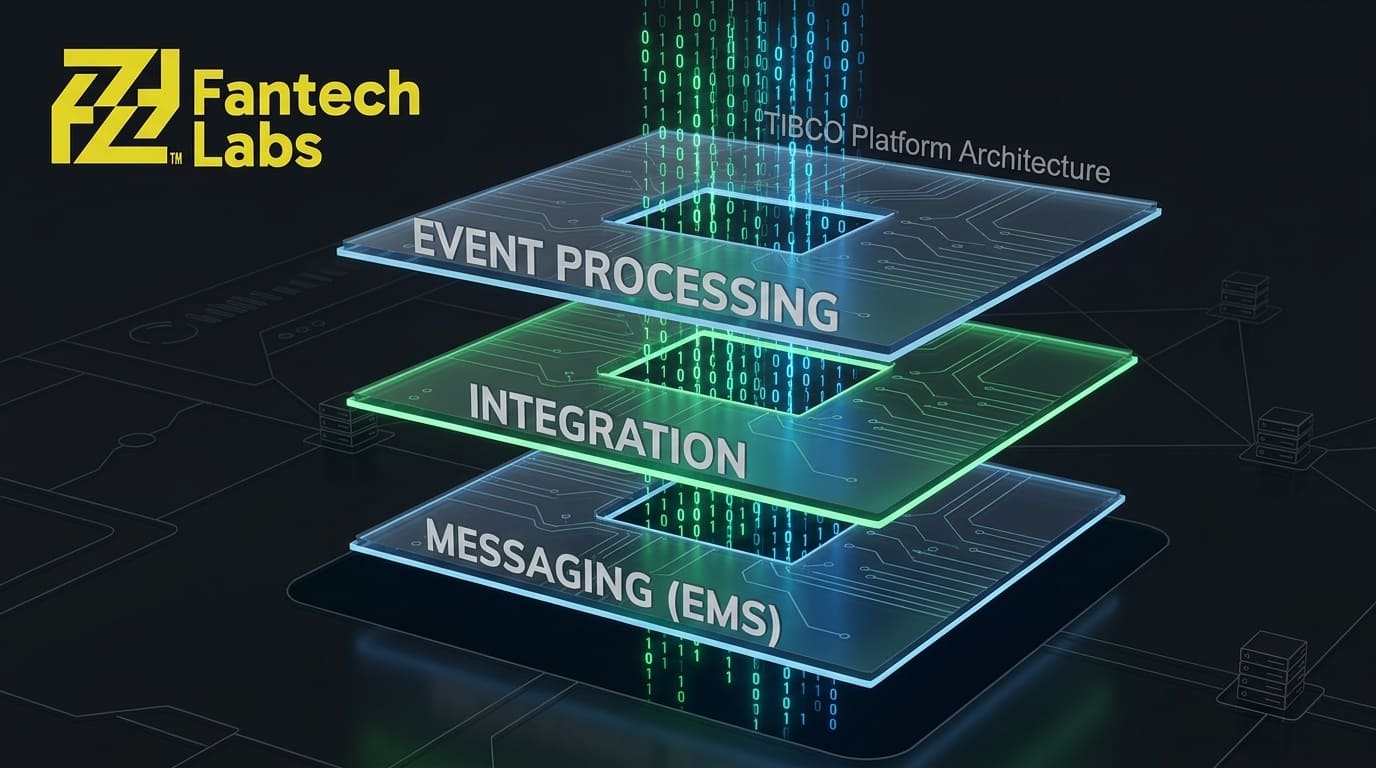
TIBCO enables faster modernization with a real-time, AI-enabled composable data platform that combines integration, messaging, data grid, event processing, and process automation while ensuring simplicity, reliability, and enterprise readiness.
Understanding how these components fit together is essential before any implementation decision.
TIBCO Messaging: The Core Infrastructure Layer
TIBCO Platform Messaging offers diverse messaging components like TIBCO Enterprise Message Service, TIBCO Messaging Quasar, and more, ensuring seamless real-time data distribution across the enterprise.
Messaging is the foundation. Every real-time data flow in a TIBCO architecture moves through the messaging layer. The messaging infrastructure handles delivery guarantees, routing, persistence, and acknowledgment — the plumbing that everything else depends on.
TIBCO Enterprise Message Service (EMS)
TIBCO Enterprise Message Service is the platform's JMS-compliant messaging backbone. It implements the Java Message Service standard, which means any JMS-compatible application can connect to it without vendor-specific client code.
EMS supports two fundamental messaging patterns that underpin event-driven architecture.
Point-to-point queues deliver each message to exactly one consumer. The sender puts a message on a queue. One consumer reads it, processes it, and acknowledges receipt. If no consumer is available, the message waits in the queue until one becomes available. This pattern is appropriate for transactional workflows where each message must be processed exactly once order processing, payment confirmation, inventory updates.
Publish-subscribe topics deliver each message to all subscribers simultaneously. The sender publishes a topic. Every application subscribed to that topic receives a copy of the message. This pattern is appropriate for event broadcasting price updates, system alerts, real-time dashboard feeds, and any scenario where multiple systems need the same data simultaneously.
TIBCO Integration: The Connectivity Layer
The platform supports real-time integration through messaging, APIs, and event processing technologies. Key TIBCO application integration features include pre-built application connectors for popular enterprise systems, support for various messaging protocols and formats, and event-driven architecture for real-time processing.
TIBCO Integration accelerates connectivity initiatives with low and no-code experiences engineered to reduce development time and costs.
The integration layer sits above the messaging layer and handles the transformation, routing, and orchestration logic that turns raw messages into meaningful business events. This is where data is mapped between formats, enriched with reference data, validated against business rules, and routed to the appropriate downstream systems.
TIBCO Event Processing
Event processing is the capability that separates real-time integration from simple messaging. The event processing layer analyzes streams of incoming events in real time, identifies patterns across multiple events, and triggers automated responses when conditions are met.
A fraud detection system that processes individual transaction messages is doing real-time integration. A fraud detection system that correlates ten transactions across three accounts in two countries within sixty seconds and automatically freezes the highest-risk account is doing event processing. The difference is whether the system reacts to individual messages or to patterns across message streams.
EVENT-DRIVEN ARCHITECTURE: THE DESIGN PATTERN TIBCO IS BUILT FOR
Event-driven architecture is the design approach where systems communicate by producing and consuming events rather than by calling each other directly. Understanding this pattern is a prerequisite for effective TIBCO implementation.
The Three Components of Event-Driven Architecture
Every event-driven system has three components: event producers, an event broker, and event consumers.
Event producers are the systems that generate events: an order management system that fires an OrderPlaced event, a sensor that fires a TemperatureReading event every second, a payment gateway that fires a PaymentAuthorized event. Producers do not know or care who will consume their events. They simply publish to a topic or queue and move on.
The event broker is the TIBCO messaging layer EMS, Quasar, or the broader messaging infrastructure. It receives events from producers, ensures delivery guarantees, routes messages to the right destinations, and maintains persistence so events are not lost if a consumer is temporarily unavailable.
Event consumers are the downstream systems that act on events, the inventory system that processes OrderPlaced events to reserve stock, the analytics platform that processes TemperatureReading events to detect equipment anomalies, the CRM that processes PaymentAuthorized events to update customer records. Consumers subscribe to the events they care about and process them independently.
Why This Architecture Creates Resilience
The critical advantage of event-driven architecture over direct API calls is decoupling. When System A calls System B directly via REST API, System A fails if System B is down. When System A publishes to a topic that System B subscribes to, System B's unavailability simply causes events to queue up and be processed when System B recovers. System A continues operating normally.
This decoupling is what allows enterprise organizations to add new systems, change existing systems, and route data to new destinations without touching the upstream systems that produce the data.
ENTERPRISE SERVICE BUS: HOW TIBCO IMPLEMENTS ESB PATTERNS
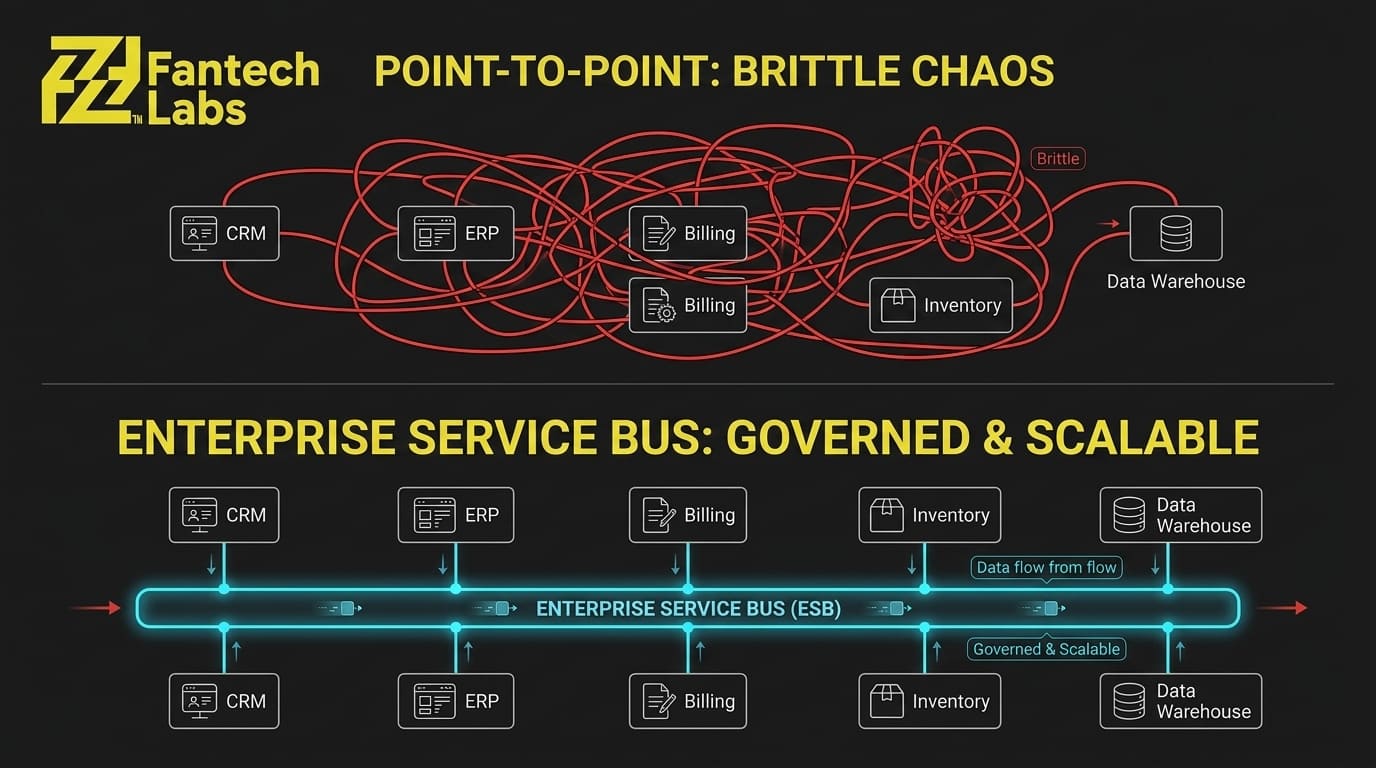
An Enterprise Service Bus is a middleware layer that acts as the central nervous system of an enterprise integration architecture. All systems connect to the bus rather than to each other. The bus handles message routing, transformation, protocol translation, and delivery guarantees.
The ESB vs Point-to-Point Comparison
In a point-to-point integration architecture with ten systems, you potentially need 45 individual connections to connect every system to every other system. Each connection has its own transformation logic, error handling, and monitoring. When any system changes its API or data format, every connection to that system must be updated.
In an ESB architecture with ten systems, each system connects once to the bus. Transformation and routing logic lives centrally on the bus. When a system changes, only the bus-to-system adapter needs updating. The 45-connection maintenance problem becomes a 10-adapter maintenance problem.
Implementing ESB Patterns with TIBCO
TIBCO implements ESB patterns through a combination of its messaging infrastructure, integration connectors, and process orchestration capabilities. A practical TIBCO ESB implementation for an enterprise team covers three layers.
The first is the connectivity layer where each enterprise system connects to the TIBCO messaging infrastructure through a dedicated adapter. TIBCO provides pre-built connectors for common enterprise systems. Custom connectors are built using TIBCO's integration tooling for proprietary or legacy systems.
The second is the transformation layer where incoming messages are converted from source system formats to canonical data models standardized schemas that all systems on the bus understand. Canonical data modeling is the most important design decision in any ESB implementation and the most commonly skipped one.
The third is the routing layer where messages are directed to the appropriate downstream topics, queues, or direct integrations based on content, business rules, or routing tables.
TIBCO EMS VS APACHE KAFKA: AN HONEST COMPARISON FOR ENTERPRISE TEAMS
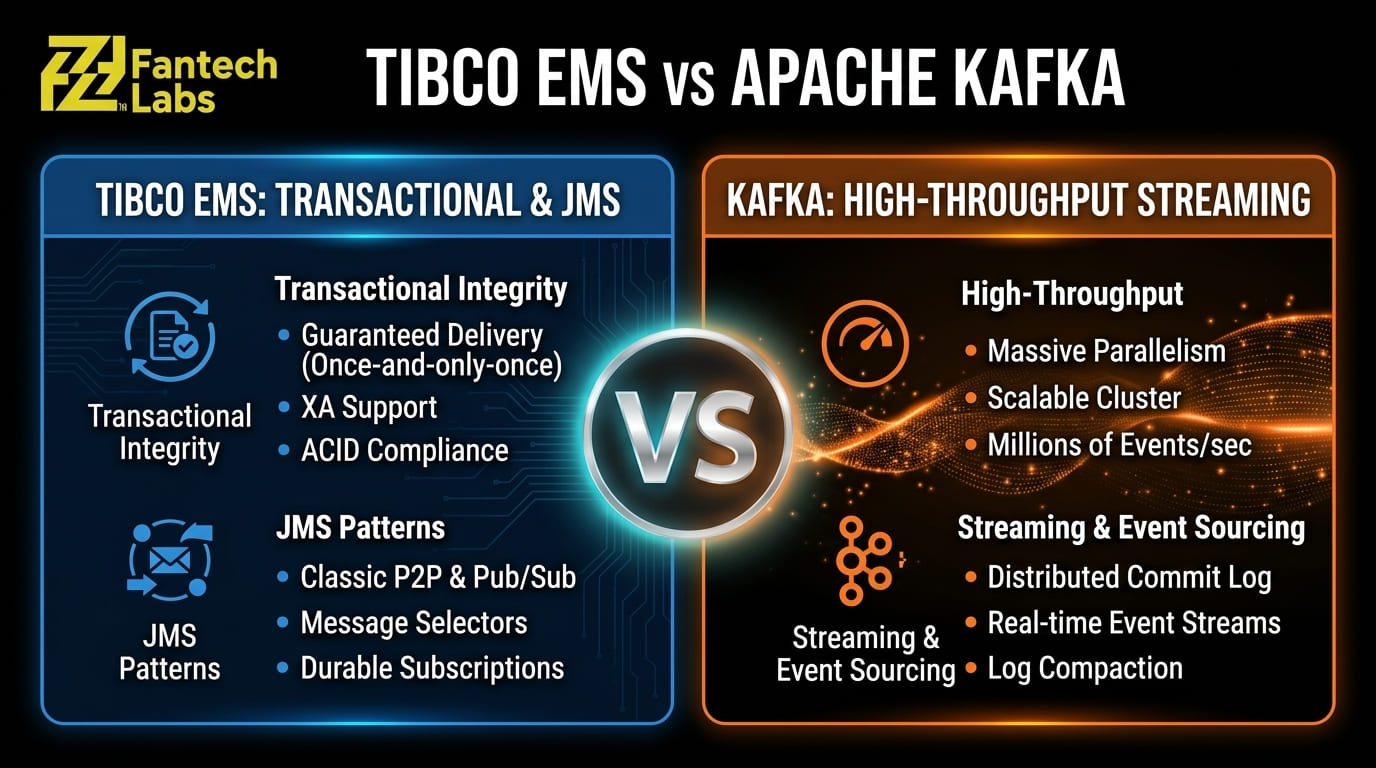
This comparison matters because the wrong choice at the architecture stage is expensive to reverse. Both TIBCO EMS and Apache Kafka are production-proven enterprise messaging technologies, but they are optimized for different use cases.
Where TIBCO EMS Wins
TIBCO EMS is the stronger choice for traditional enterprise messaging use cases that require JMS compatibility, guaranteed message ordering within queues, transactional message processing with two-phase commit, point-to-point queue semantics with exactly-once delivery, and request-reply patterns where a response is expected from the consumer.
EMS is also the appropriate choice when your enterprise already runs TIBCO and the architectural consistency of staying within the platform outweighs the benefits of introducing Kafka.
Where Apache Kafka Wins
Apache Kafka is the stronger choice for high-throughput streaming use cases. Kafka is designed to handle millions of messages per second with sub-millisecond latency at scale. TIBCO's data bus has real throughput limitations at two companies where TIBCO was implemented, one ended up doing a complete rollback and the other had to deploy a parallel high-performance data bus to handle the heavy lifting.
This is an honest assessment that most TIBCO documentation glosses over. For IoT sensor streams producing thousands of events per second per device, financial market data feeds, large-scale log aggregation, and real-time analytics pipelines processing millions of events per hour, Kafka's architecture is fundamentally better suited.
Kafka is also the stronger choice when message replay is required — the ability to re-read historical events from the stream. Kafka retains messages for a configurable retention period, allowing consumers to replay events for debugging, reprocessing after a bug fix, or populating a new downstream system with historical data. Traditional message queues like EMS delete messages after they are consumed.
The Hybrid Architecture
Many large enterprises run both. TIBCO EMS handles transactional enterprise integration where exactly-once delivery and request-reply patterns matter. Kafka handles high-volume event streaming where throughput and replay capability matter. A central integration layer translates between the two where necessary.
Fantech Labs has experience designing hybrid messaging architectures that combine TIBCO's enterprise integration capabilities with Kafka's streaming performance. Learn more at fantechlabs.ca/services.
COMMON TIBCO IMPLEMENTATION MISTAKES AND HOW TO AVOID THEM
The most expensive TIBCO implementation failures share the same patterns. Understanding these before starting a project saves significant time and money.
Mistake 1: Skipping Canonical Data Model Design
The most important architectural decision in any ESB implementation is the canonical data model, the standardized schema that all systems use when communicating through the bus. Skipping canonical modeling and mapping each system's native format directly to each other's format recreates the point-to-point complexity problem inside the ESB rather than solving it.
Invest the design time in canonical modeling before writing any integration code. Every hour spent on canonical design saves ten hours of transformation code maintenance later.
Mistake 2: Building Point-to-Point Flows Inside the ESB
Many teams adopt TIBCO but continue building point-to-point flows because it feels faster in the short term. A TIBCO flow that connects System A directly to System B without going through a canonical model or a reusable service is point-to-point integration with TIBCO as the transport. It solves the delivery problem but not the coupling problem.
Design every integration as a service on the bus: System A publishes an event in canonical format, the bus routes it to all interested subscribers, each subscriber processes it independently.
Mistake 3: Insufficient Error Handling and Dead Letter Queues
Every enterprise messaging system needs a dead letter queue — a destination for messages that fail processing after all retry attempts are exhausted. Without a dead letter queue, failed messages are silently lost and the data discrepancy surfaces hours or days later when a downstream system reports inconsistent state.
Configure dead letter queues for every queue and topic. Build monitoring that alerts on dead letter queue depth. Define a process for reviewing, correcting, and reprocessing failed messages before they are treated as permanent losses.
Mistake 4: No Message Schema Governance
In a production TIBCO environment, dozens of systems publish to dozens of topics. Without schema governance formal definitions of what each topic carries and a process for managing schema changes producers and consumers drift out of sync. A schema change in an upstream system breaks all downstream consumers without warning.
Implement a schema registry or at minimum formal schema documentation with a change notification process. Schema versioning and backward compatibility planning must be part of your messaging architecture from the start.
Mistake 5: Treating TIBCO Configuration as Code
TIBCO configuration is code. It defines business logic, routing rules, transformation mappings, and delivery guarantees. Treating it as operational configuration rather than source code means no version control, no code review, and no audit trail. Changes made directly in production become invisible technical debt.
Store all TIBCO configuration in version control. Apply the same code review and deployment pipeline standards you apply to application code.
LOW-LATENCY DATA FLOW: PRACTICAL CONFIGURATION PATTERNS
For enterprise teams where latency is a business requirement not just a technical preference, these configuration patterns deliver the lowest latency within TIBCO's architecture.
Persistent vs Non-Persistent Messages
TIBCO EMS supports persistent and non-persistent message delivery. Persistent messages are written to disk before the broker acknowledges receipt, guaranteeing no message loss even if the broker crashes. Non-persistent messages are kept in memory only, offering significantly lower latency but with the risk of message loss on broker failure.
For use cases where sub-millisecond latency is more important than guaranteed delivery market data feeds, real-time monitoring dashboards, sensor telemetry non-persistent delivery with appropriate consumer-side buffering delivers the best performance.
For transactional use cases where message loss is unacceptable order processing, financial transactions, inventory updates, persistent delivery with appropriate hardware (SSD storage, sufficient RAM) maintains acceptable latency while guaranteeing delivery.
Connection Pooling and Consumer Thread Configuration
High-throughput TIBCO consumers should use connection pooling rather than creating a new connection per message processing operation. Connection establishment is expensive relative to message processing. A pool of pre-established connections dramatically reduces per-message overhead at high volumes.
Consumer thread configuration should be tuned to match available CPU cores and message processing time. Underthreading leaves CPU capacity unused. Overthreading creates context switching overhead that reduces throughput.
Message Batching for Analytics Pipelines
For analytics use cases where individual message latency is less important than aggregate throughput, consumer-side batching accumulating N messages before processing them together significantly increases throughput at the cost of individual message processing latency. This pattern is appropriate for data warehouse ingestion, reporting pipelines, and non-operational analytics flows.
TIBCO IN CANADA: COMPLIANCE AND DATA RESIDENCY CONSIDERATIONS
Canadian enterprise organizations implementing TIBCO must consider PIPEDA compliance for any integration that moves personal information between systems.
PIPEDA requires that personal data be protected with appropriate security safeguards at every point in its lifecycle — including in transit across messaging infrastructure. TIBCO EMS supports TLS encryption for all message transport, which satisfies the encryption-in-transit requirement. Data at rest in persistent message stores must also be encrypted if it contains personal information.
For organizations in regulated industries — financial services under OSFI, healthcare under provincial health information acts, or government — data residency requirements may restrict which cloud regions can be used for TIBCO Cloud Integration deployments. AWS Canada in the Montreal region and Azure Canada in the Toronto and Quebec City regions both support TIBCO Cloud Integration deployments with Canadian data residency.
Fantech Labs builds PIPEDA-compliant integration architectures for Canadian enterprises and can advise on data residency configuration for TIBCO implementations. Learn more at fantechlabs.ca/contact-us.
COMPARE OPTIONS WITH FANTECH LABS
Step 1: Book a consultation at fantechlabs.ca/contact-us to discuss your current integration architecture and real-time data requirements.
Step 2: We conduct a technical assessment of your existing systems, data flows, and messaging volumes to determine whether TIBCO, Kafka, MuleSoft, or a hybrid architecture best fits your requirements.
Step 3: A formal architecture design phase produces integration patterns, canonical data model design, and a phased implementation roadmap.
Step 4: Implementation proceeds with full source control for all configuration, comprehensive error handling, and monitoring from day one.
Step 5: Post-implementation support includes performance tuning, schema governance, and ongoing architecture evolution as your integration requirements grow.
Frequently Asked Questions
What is real-time data integration?
Real-time data integration is the process of moving, transforming, and making data available across systems within milliseconds of an event occurring. Unlike batch integration which processes data in scheduled intervals, real-time integration ensures every system has access to current data immediately after it changes at the source.
What is TIBCO EMS and how does it work?
TIBCO Enterprise Message Service is a JMS-compliant messaging backbone that supports point-to-point queues and publish-subscribe topics. Producers send messages to queues or topics. The EMS broker stores and routes messages. Consumers receive messages from queues or subscribe to topics. EMS guarantees delivery, handles persistence, and supports transactional message processing.
What is event-driven architecture?
Event-driven architecture is a design pattern where systems communicate by producing and consuming events through a central messaging infrastructure rather than calling each other directly. This decouples producers from consumers, creates resilience when individual systems are unavailable, and allows new consumers to be added without modifying existing producers.
What is an Enterprise Service Bus?
An Enterprise Service Bus is a middleware layer where all systems connect to a central bus rather than to each other. The bus handles message routing, format transformation, protocol translation, and delivery guarantees. This reduces the number of integration connections from N-squared to N and centralizes transformation logic.
How does TIBCO compare to Apache Kafka?
TIBCO EMS is stronger for transactional enterprise integration requiring JMS compatibility, exactly-once delivery, and request-reply patterns. Apache Kafka is stronger for high-throughput streaming use cases processing millions of messages per second and for use cases requiring message replay. Many large enterprises run both for different use cases.
Does TIBCO support PIPEDA compliance for Canadian organizations?
TIBCO EMS supports TLS encryption for all message transport satisfying the encryption-in-transit requirement. TIBCO Cloud Integration can be deployed in Canadian cloud regions for data residency compliance. Additional configuration is required for at-rest encryption of persistent message stores containing personal information.
What is the most common TIBCO implementation failure?
The most common failure is treating TIBCO as a transport for point-to-point flows rather than implementing a proper canonical data model and bus architecture. This recreates the coupling problem inside the TIBCO platform instead of solving it, and is significantly more expensive to correct after implementation than to design correctly from the start.
SUMMARY: REAL-TIME DATA INTEGRATION WITH TIBCO FOR ENTERPRISE TEAMS IN 2026
First, design your canonical data model before writing any integration code. Every hour spent on schema design saves ten hours of transformation maintenance later.
Second, choose the right messaging pattern for each use case. Point-to-point queues for transactional exactly-once processing. Publish-subscribe topics for event broadcasting to multiple consumers.
Third, evaluate TIBCO EMS against Apache Kafka honestly for high-throughput use cases. TIBCO is not the right architecture for every messaging volume, and the most experienced TIBCO implementers know this.
Fourth, implement dead letter queues, error logging, and monitoring from the first day of implementation. Silent message loss is the most operationally expensive failure mode in any messaging system.
Fifth, store all TIBCO configuration in version control and apply the same code review standards you apply to application code. Configuration is code.
Book Your Enterprise Integration Consultation at Fantech Labs →
Conclusion
Real-time data integration with TIBCO is a proven approach for enterprise teams that need reliable, governed, low-latency data flows across complex system landscapes. The technology is mature and capable. The implementation failures that do occur almost universally trace back to architectural decisions made before the first line of configuration was written — not to platform limitations. Getting the architecture right, choosing the right patterns for each use case, and treating TIBCO configuration as production code from day one determines whether a TIBCO implementation becomes a durable integration foundation or an expensive maintenance burden.
Why Trust Fantech Labs
At Fantech Labs, we build software that solves real business problems for Canadian companies. Our senior developers are directly involved in every project, our case studies are published with real client names, and our post-launch support is structured rather than ad hoc.
Disclaimer: Information provided is for educational purposes only. Technology capabilities, platform features, and compliance requirements are subject to change. Always consult qualified technical and legal professionals before making enterprise architecture decisions.
Author Bio
Saim Muneer | Senior Integration Architect
Saim Muneer is a Senior Integration Architect at Fantech Labs. He specializes in designing robust event-driven architectures and real-time data pipelines using TIBCO, MuleSoft, and Apache Kafka. With a strong focus on eliminating integration debt, Saim helps Canadian enterprises build secure, low-latency, and PIPEDA-compliant middleware solutions that drive operational efficiency.