_Z1hODcx.webp)
By Mussaddiq Mahmood, CRM and AI Automaiotn specialist at Fantech Labs - last updated 9/23/2026
Key Takeaways
- In 2026, the mortgage brokerage that responds to a lead first tends to win the deal. 78% of customers buy from the first company that responds to their inquiry, a widely cited lead-response benchmark. AI automation removes the human delay between a lead arriving and a broker making contact.
- Implementation runs 8 to 16 weeks depending on scope, and measurable ROI typically shows up within 90 days.
- One independent mortgage processing company, a Miami-based client of AI automation agency Wisdom Stream, documented 2 to 3 hours per processor per day in time savings after deploying automation on top of its existing Encompass system.
- The five workflow stages that deliver measurable ROI for North American mortgage brokers are document intake, income and asset verification, conditions tracking, compliance review, and post-close follow-up.
- Payback periods for a full automation deployment at a mid-size brokerage typically run 4 to 6 months, based on recovered loan officer time, faster document collection, and growth in referral partner volume.
- The right automation partner does not sell a product. It maps your current process, finds where manual work follows a consistent pattern, and builds integrations on top of the tools you already use. See how Fantech Labs' AI integration services in Calgary approach this for clients across North America.
WHY MORTGAGE BROKERS ARE HIRING AI AUTOMATION COMPANIES IN 2026
The competitive environment for North American mortgage brokers has shifted in a way that's hard to undo. In Canada, OSFI removed the stress-test requirement for uninsured "straight switch" renewals as of November 21, 2024, making it easier for borrowers to shop around at renewal instead of defaulting back to their existing lender. In the US, digital mortgage applications have become the norm rather than the exception, and borrower expectations for speed have risen to match.
The practical effect is that the brokerage that responds fastest and gets a clean file to the lender first tends to win the deal, more often than the one with the lowest rate or the most years in the business. Brokerages still running manual review loops and disconnected software feel that gap directly: slower approvals lose deals, rising operational costs eat into margins, and manual handoffs increase the odds of an error that triggers a compliance review. Borrowers, meanwhile, get frustrated by repeated document requests and updates that never come.
The brokerages closing that gap generally aren't adding headcount. They're automating the manual, pattern-driven work so brokers and processors can spend their time on the parts of the job that actually require judgment.
WHAT AI AUTOMATION FOR MORTGAGE BROKERS ACTUALLY COVERS
AI automation for a mortgage brokerage isn't a software subscription. It's a built, integrated workflow system that connects the platforms a brokerage already uses and removes the manual steps in between.
A mortgage automation partner maps the current process from lead capture to funded loan, identifies which steps follow a consistent, repeatable pattern, and builds integrations that run automatically on top of the existing loan origination system, CRM, and communication tools. The broker's team still makes every judgment call that requires actual expertise. The automation handles everything that doesn't.
| Workflow Stage | What Gets Automated | Time Saved Per File |
|---|---|---|
| Document intake and classification | Receiving, sorting, and labeling uploaded borrower documents | 45 to 90 minutes |
| Income and asset verification | Extracting data from pay stubs, T4s, bank statements, tax returns | 30 to 60 minutes |
| Conditions tracking and clearing | Monitoring outstanding conditions, sending reminders, updating status | 20 to 40 minutes |
| Compliance and disclosure review | Flagging missing disclosures, checking against compliance rules | 15 to 30 minutes |
| Post-close follow-up | Thank-you sequences, review requests, renewal pipeline outreach | 10 to 20 minutes |
Across a full deployment covering all five stages, the combined time saving tends to land around 2 to 3 hours per processor per day, consistent with the Wisdom Stream case study cited above, where a five-processor Encompass shop saw the same range. At a brokerage processing 30 files a month with two processors, that works out to 120 to 180 hours a month returned to revenue-generating work.
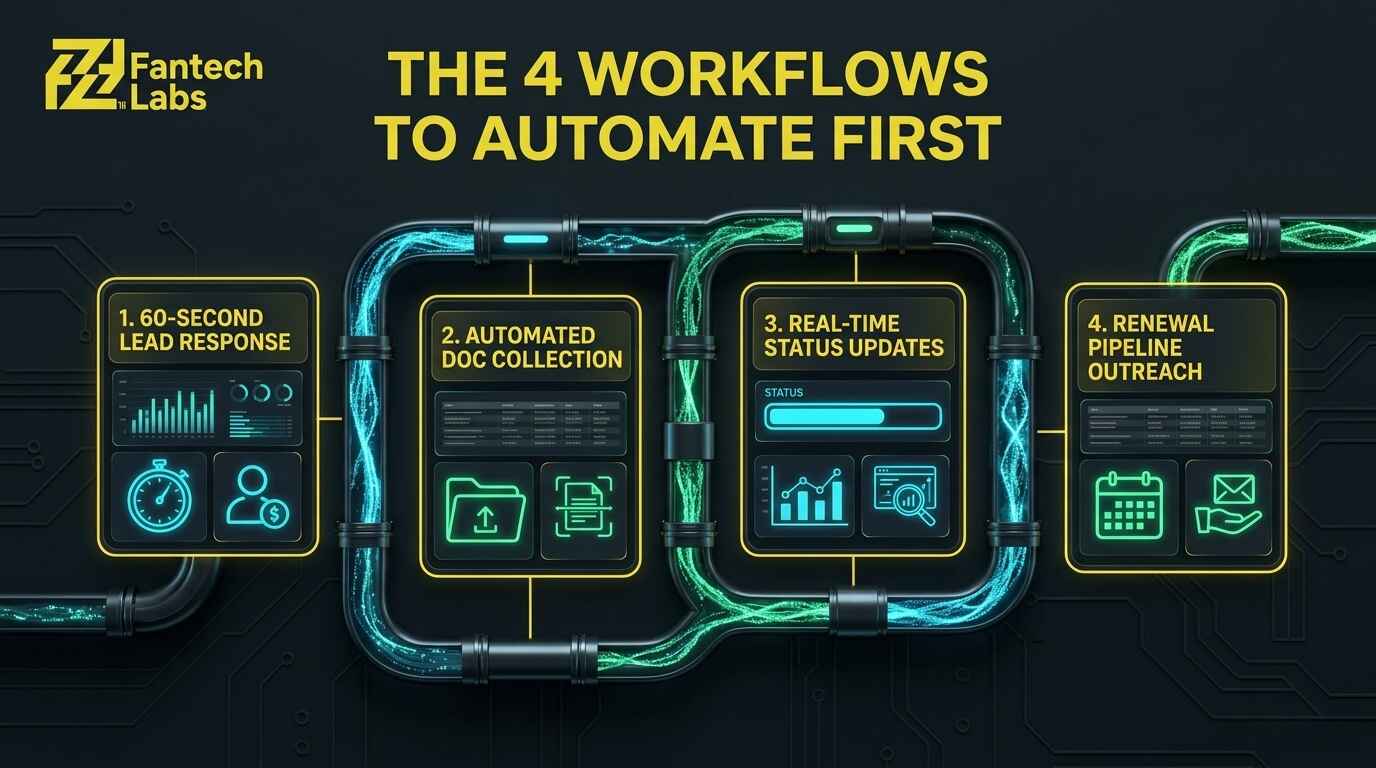
THE FOUR WORKFLOWS TO AUTOMATE FIRST
1. Lead Response and Qualification
The single highest-ROI automation for a North American mortgage brokerage is the one that connects a new lead to a broker faster than any competitor can manage. Roughly 78% of borrowers hire the first broker to contact them, and in a market where borrowers submit inquiries to three or four brokers at once through aggregator platforms, being second usually means losing the deal outright.
A lead response automation connects the brokerage's lead sources (its website, a Canadian aggregator like Ratehub or Ratesdotca, a US platform like LendingTree, or a referral CRM) to a sequence that sends a personalized acknowledgment within 60 seconds, asks qualification questions by SMS or email based on where the lead came from, creates a deal in the CRM with the captured information pre-populated, and alerts the assigned broker once the file is ready for a discovery call. The broker's first real interaction with the lead becomes the discovery call, not the initial acknowledgment, which changes close rates meaningfully on its own.
2. Document Collection and Follow-Up
The average North American mortgage file needs 15 to 20 documents from the borrower before it's submission-ready. Collecting those manually means individual emails, tracking what's arrived and what hasn't, chasing borrowers who've gone quiet, and confirming receipt by hand. Across a 30-deal month, that consumes 4 to 6 hours of processor or broker time per week that generates no revenue and no goodwill.
A document collection automation sends a customized request list right after the discovery call, follows up automatically at set intervals on anything outstanding, confirms receipt of each document as it arrives, and notifies the processor once the file is complete. Borrowers get faster confirmations, and the processor stops spending their week chasing paperwork.
3. Status Communication and Borrower Updates
Borrowers who don't hear from their broker tend to start looking elsewhere. Status anxiety during a mortgage process is one of the more reliable drivers of mid-process abandonment, and manual updates require someone to check the file, write a message, and send it at every stage change for every borrower.
An automated status system fires a borrower update the moment a file moves to a new stage in the loan origination system: submission confirmed, underwriter received, conditions issued, clear to close, funded. Each message goes out within minutes without anyone composing it by hand, and because the updates are timely, response rates to them tend to be high.
4. Renewal Pipeline Outreach
The mortgage renewal pipeline is one of the most consistently underused revenue sources in North American brokerages. About 1.2 million Canadian mortgages are expected to renew across 2025 and 2026, largely 5-year fixed terms signed in 2021, which makes this a significant opportunity for any brokerage with an existing client book. A brokerage with 400 funded mortgages has a renewal opportunity arriving every month, but manually tracking 90-to-120-day pre-renewal windows across hundreds of clients isn't realistically possible without automation.
A renewal pipeline automation pulls clients approaching their renewal window from the CRM, starts a pre-renewal outreach sequence with rate information relevant to their original product, checks whether the client plans to renew with the same lender, switch, or refinance, and routes them to the right broker workflow based on the response. It turns a passive book of past clients into an active pipeline without adding any broker time.
WHAT IT COSTS TO HIRE A MORTGAGE AUTOMATION COMPANY
Understanding the full cost structure up front prevents the two most common surprises: underestimating implementation cost, and not budgeting for ongoing maintenance.
| Engagement Type | What's Included | Typical Cost | |||
|---|---|---|---|---|---|
| Workflow audit and scoping | Process mapping, automation roadmap, ROI estimate | $0 to $2,500 | |||
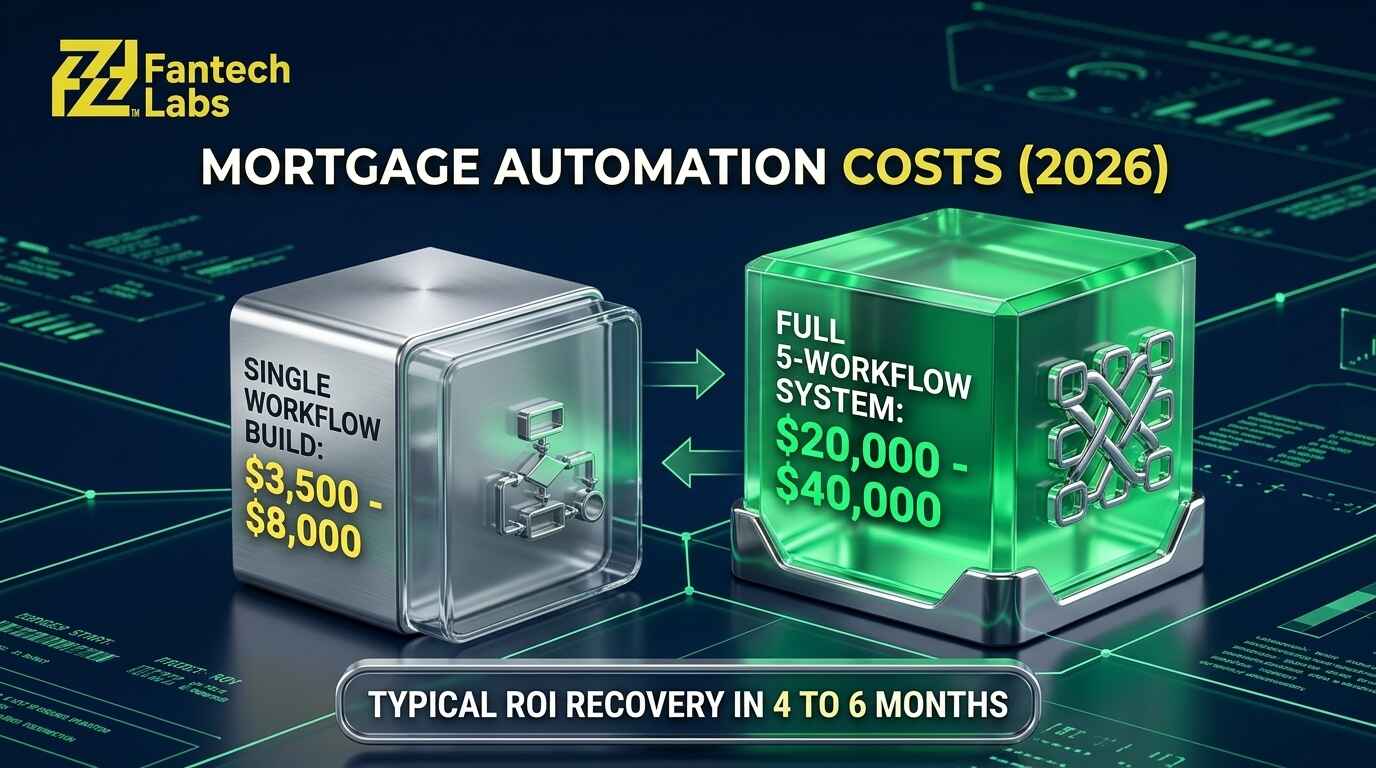
| Single workflow build | One defined end-to-end process, e.g. lead response | $3,500 to $8,000 one-time | Starter automation package | 3 core workflows, discovery, build, testing, documentation | $12,000 to $25,000 one-time |
| Full brokerage automation system | 5 to 7 workflows, LOS integration, CRM connections, training | $25,000 to $60,000 one-time | |||
| Monthly managed service | Monitoring, optimization, support, new workflow additions | $1,500 to $5,000/month | |||
| Ongoing retainer (full service) | Dedicated automation team, strategy, builds, reporting | $4,000 to $10,000/month |
The Wisdom Stream case study referenced above puts a real number behind the lower end of that range: a small mortgage processing operation reportedly paid $3,500 in initial implementation cost and had documented 2 to 3 hours per processor per day in time savings within three months, a gain substantial enough to justify additional hiring.
For a mid-size North American brokerage automating three to five workflows, all-in first-year cost typically lands between $20,000 and $40,000, covering discovery, build, testing, training, and the first year of managed support. Most brokerages recover that investment within 4 to 6 months through reduced processing hours and better lead conversion.
HOW MORTGAGE AUTOMATION DIFFERS BETWEEN THE US AND CANADA
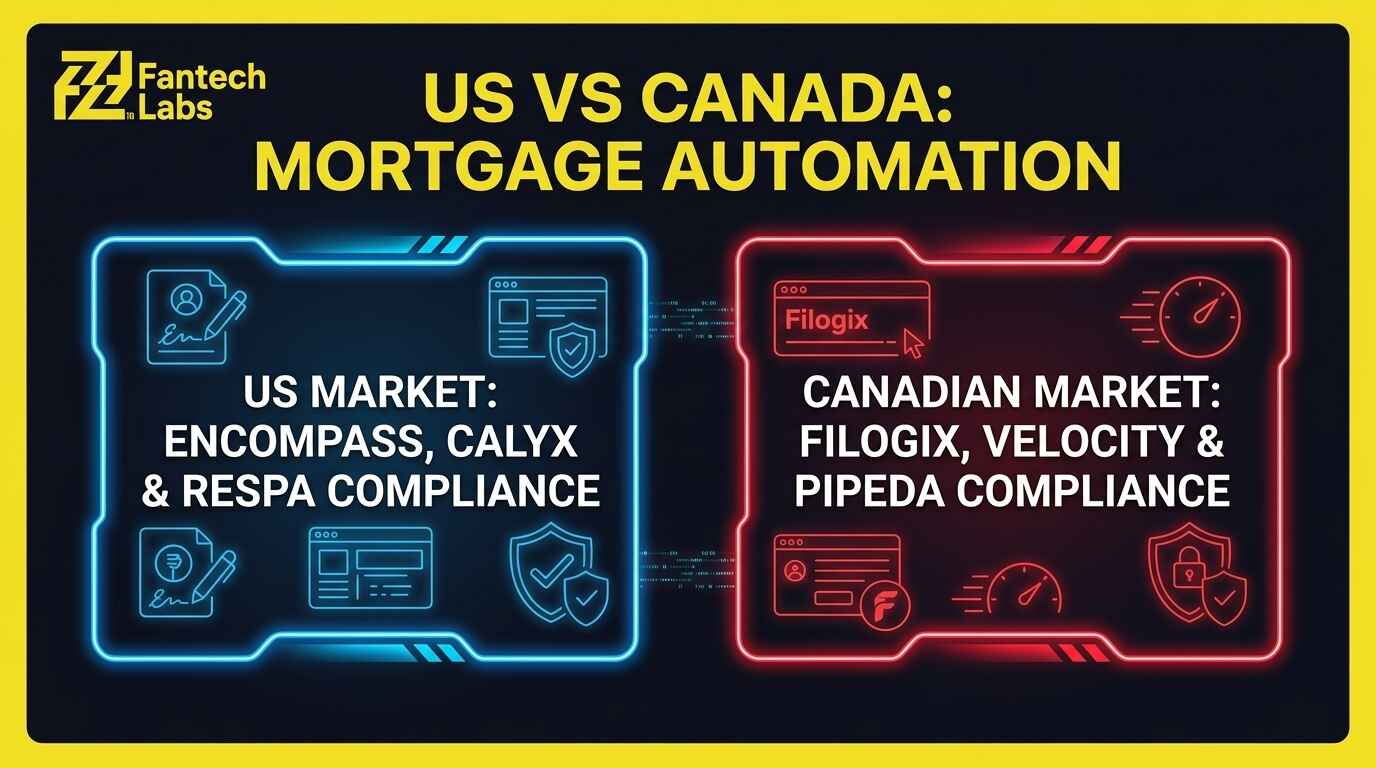
North American mortgage brokers operate in different regulatory environments and different platform ecosystems depending on which side of the border they're on, and the right automation partner accounts for both.
| Factor | United States | Canada |
|---|---|---|
| Dominant LOS platforms | Encompass (ICE), Byte, Calyx Point | Filogix, Velocity, Finmo |
| Primary CRM tools | Salesforce, HubSpot, Total Expert, Jungo | GoHighLevel, HubSpot, Salesforce |
| Key regulatory considerations | RESPA, TRID, state-level licensing | OSFI, FSRA (Ontario), PIPEDA, provincial privacy law |
| Rate aggregator platforms | LendingTree, Bankrate, Credible | Ratehub, Ratesdotca, nesto |
| Renewal cycle significance | Less pronounced (30-year terms typical) | High (5-year terms standard; roughly 1.2 million renewing in 2025-2026) |
In Canada, Filogix and Velocity are the dominant origination platforms, and neither has the out-of-the-box connectors that mainstream tools like Zapier or Make offer for common SaaS products. Connecting a CRM, document management system, and Filogix or Velocity into one automation system takes custom API work that a general-purpose automation agency usually can't deliver without a steep learning curve on the client's dime.
PIPEDA applies to every client data point an automation system touches in Canada. In the US, state-level privacy laws and RESPA shape what borrower data can be used for automated outreach and how consent needs to be documented. A partner worth hiring treats these as design requirements from the outset, not as something to retrofit after launch.
WHAT TO LOOK FOR WHEN HIRING AN AUTOMATION PARTNER
Choosing a mortgage automation company is a bigger decision than choosing a software vendor. The partner will map business processes, build integrations between existing tools, and maintain those integrations as the business and the regulatory environment both change.
| Factor | What Good Looks Like | Red Flag |
|---|---|---|
| Mortgage industry experience | Has built automations for other brokerages, references available | Generic case studies, no financial services examples |
| Process mapping before build | Process mapping before build | Demo before understanding your workflows |
| LOS integration experience | Specific experience with your LOS (Encompass, Filogix, Velocity, etc.) | Hasn't worked with your specific platform before |
| Regulatory awareness | Raises PIPEDA, RESPA, or state privacy questions unprompted | No mention of compliance in discovery conversations |
| Tool agnosticism | Recommends based on your existing stack | Pushes a proprietary platform regardless of fit |
| Post-launch support | Defined SLA, named account contact, monitoring included | Hands the system over and disappears after go-live |
| Transparent pricing | Itemized scope, no hidden per-workflow charges | Lump sum quote with no breakdown |
| Ownership of the automation | You own the workflows, credentials, and access | Agency retains ownership or control of your systems |
Before signing anything, confirm there's an itemized scope, a defined post-launch support period, a clear answer on data residency and compliance, and a 30-day exit clause. Who owns the workflow logic and who decides what happens to it matters more every year, and it's not worth outsourcing that decision to a vendor whose interests might not stay aligned with yours eighteen months from now.
THE 90-DAY AI AUTOMATION ROADMAP
Days 1 to 30, Foundation and Lead Response. Map the current lead-to-disclosure workflow on paper before touching any tool. Identify where broker and processor time gets consumed by tasks that follow a consistent pattern. Build and deploy a single lead response automation connecting the top lead source to the CRM, sending an acknowledgment within 60 seconds. Measure lead response time before and after. This one data point becomes the foundation for the ROI case behind every automation that follows.
Days 31 to 60, Document Collection and Status Communication. Layer document collection automation on top of the discovery call workflow. Build a status communication sequence that triggers automatically at each loan stage. Automate reminders for borrowers who haven't uploaded outstanding items. Measure processor hours per file before and after, and document the difference specifically.
Days 61 to 90, Renewal Pipeline and Optimization. Activate renewal pipeline outreach for clients with mortgages maturing in the next 90 to 120 days. Review the first two automations, cut whatever isn't performing, and reinvest in what is. Layer in follow-up for leads that didn't convert in the previous 60 days. Compare cost per funded loan against the pre-automation baseline.
By day 90, there's real operational data to work from: cost per funded loan before and after, the lead response time improvement, and processor hours per file. Every automation investment after that point gets justified by that data, not by a vendor's marketing claims.
FREQUENTLY ASKED QUESTIONS
What AI automation services do mortgage brokers in the US and Canada actually need?
The four that deliver the fastest ROI are lead response and qualification, document collection and follow-up, status communication to borrowers, and renewal pipeline outreach. Lead response ensures every new inquiry gets a personalized contact within 60 seconds regardless of when it arrives. Document collection removes the manual chase for paperwork. Status communication keeps borrowers informed at every stage without processor involvement. Renewal pipeline outreach turns a passive client book into an active revenue stream. All four can typically be built, tested, and running within 4 to 8 weeks of engagement start.
How much does it cost to hire an AI automation company for a mortgage brokerage?
For a brokerage automating three to five core workflows, all-in first-year cost typically runs $20,000 to $40,000, including discovery, build, testing, training, and the first year of managed support. A focused single-workflow build for lead response or document collection runs $3,500 to $8,000 one-time. Monthly managed service runs $1,500 to $5,000 depending on complexity.
How is AI automation for Canadian mortgage brokers different from US mortgage brokers?
Canadian brokers run primarily on Filogix and Velocity, which need custom API integration that generic automation tools can't provide without specialist experience. PIPEDA applies to all borrower data in Canadian automations, and the renewal cycle represents a much larger opportunity in Canada than the US, since most Canadian mortgages sit on 5-year terms and roughly 1.2 million are renewing across 2025 and 2026. US brokers are more commonly on Encompass and subject to RESPA, TRID, and state-level privacy rules. A partner worth hiring understands both markets and builds compliance into the design rather than bolting it on afterward.
How long does it take to implement AI automation for a mortgage brokerage?
Implementation typically runs 8 to 16 weeks depending on scope and how many systems need integrating. A single-workflow lead response build takes 2 to 4 weeks from discovery call to go-live. A starter package covering three core workflows takes 4 to 8 weeks. A full system covering five to seven workflows with LOS integration takes 8 to 16 weeks. ROI typically shows up within 90 days of go-live based on measured time savings and lead conversion improvement.
Does AI automation replace mortgage brokers or processors?
No. It removes the repetitive, pattern-driven tasks that consume broker and processor time but don't require human judgment. Brokers still run discovery calls, advise on product selection, manage lender relationships, and handle complex file situations. Processors still review flagged exceptions and make underwriting-related calls. The automation handles lead acknowledgment, document requests, status updates, compliance checklists, and renewal outreach at a speed and consistency no person can match at that scale, which frees brokers and processors to spend more of their time on the work that actually needs their expertise.
SUMMARY
The mortgage brokerages pulling ahead in 2026 generally aren't winning on rate. They're winning on speed and consistency in the repetitive steps between a lead coming in and a file landing cleanly at a lender. Lead response, document collection, status updates, and renewal outreach are the four workflows that move the needle fastest, and a brokerage doesn't need to automate all of them at once to start seeing a return. Starting with lead response alone, given how directly it ties to close rate, is usually enough to fund the next phase of the build.
WHY TRUST THIS CONTENT
Fantech Labs is a Calgary-based AI automation and system integration company serving mortgage brokerages across the US and Canada, from Filogix and Velocity in Canada to Encompass and Calyx in the US. This piece is written by Mussaddiq Mahmood, AI Automaiotn specialist at Fantech Labs. Cost and timeline figures reflect Fantech Labs' own scoping ranges for brokerage clients; the third-party case study, regulatory changes, and renewal statistics cited above are independently sourced and linked so they can be verified directly.
DISCLAIMER
Costs, timelines, and regulatory details reflect conditions as of 2026 and vary by brokerage size, existing tech stack, and jurisdiction. The third-party case study referenced in this piece describes a client of a different automation agency (Wisdom Stream) and is cited as an industry data point, not a Fantech Labs result. Talk to Fantech Labs directly for a scoped estimate based on your brokerage's actual workflows.
Book a Free Mortgage Workflow Audit, or read more about Fantech Labs' AI integration services in Calgary.