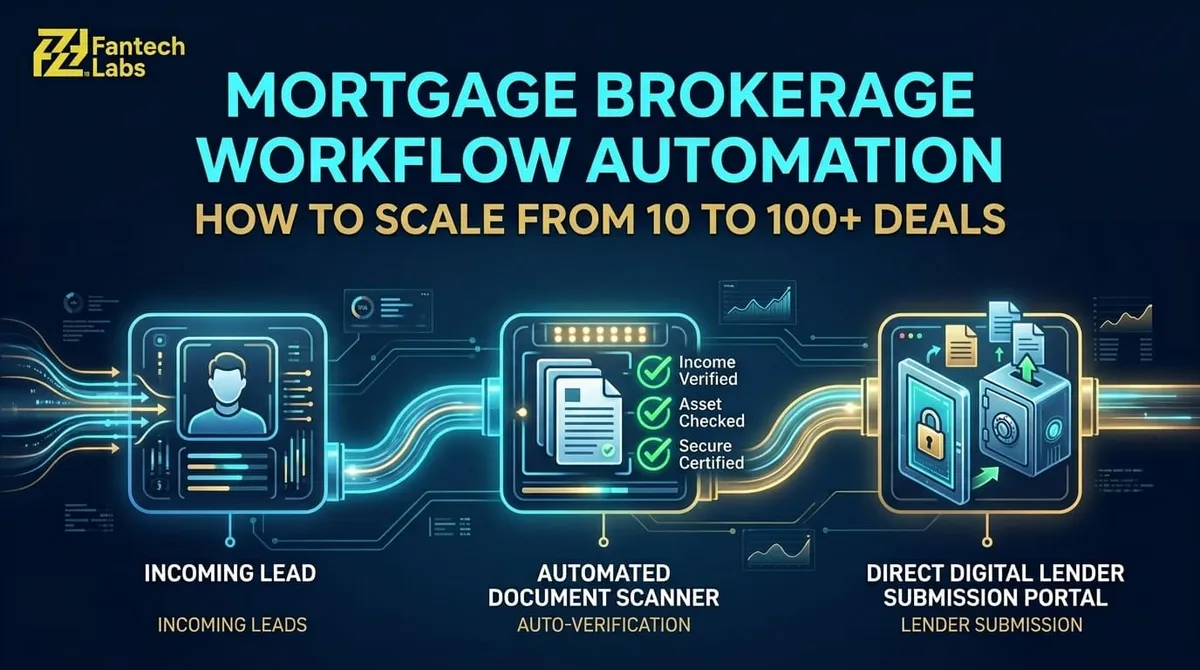
By Mussaddiq Mahmood, Automation Specialist at Fantech Labs - last updated sep 14 2026
Key Takeaways
- Mortgage brokerages that automate lead follow-up, document collection, and lender submission report saving 15 to 20 hours per broker per week, based on Fantech Labs' work with brokerage clients.
- Across Fantech Labs' SMB clients with 5 to 25 employees, the average annual labor-equivalent value of AI workflow automation is $78,000 per client.
- A single automation build covering three workflows and five integrated tools has delivered a 12-month ROI near 400% for a mortgage brokerage client, and a three-year net value above $170,000 from an upfront investment under $12,000.
- 78% of customers buy from the first company that responds to their inquiry, a widely cited lead-response benchmark. For mortgage brokers, that determines who wins the deal more than rate or reputation does.
- Small brokerages automating two or three workflows should budget $1,000 to $3,500 per month for a managed automation service. Mid-market brokerages running a full multi-workflow stack should plan for $4,000 to $10,000 per month.
- Lead follow-up, document collection, and lender submission prep are the three workflows that deliver the fastest ROI for a Canadian mortgage brokerage, and all three can typically be built and running within 4 to 6 weeks of engagement start.
WHY MORTGAGE BROKERAGES ARE A GOOD FIT FOR AUTOMATION
A mortgage brokerage runs on the same handful of steps for almost every deal: a lead comes in, gets contacted, submits documents, gets chased for the documents they didn't submit, and eventually gets packaged and sent to a lender. That repetition is exactly what automation is good at. It's also exactly where brokers lose the most time, because none of those steps require judgment so much as they require someone available at the right moment.
The speed piece matters more than most brokers assume. Research consistently shows that around 78% of customers buy from the company that responds to their inquiry first, a benchmark repeated across enough independent studies of B2B and B2C lead response that it holds up as a directional industry norm, even though no single dataset owns the exact number. A brokerage competing on rate alone is fighting a losing battle against a competitor who simply answers the phone, or the inbound lead form, faster. Automated lead follow-up turns "whoever gets to it first today" into "whoever gets to it first, every time," which is a structural advantage a manual process can't consistently match.
There's a second reason brokerages in particular are a strong fit: the work is high-stakes but low-judgment. A missed follow-up or a document that sits unrequested for three days doesn't just waste time, it can lose a deal to a competing brokerage or push a borrower's rate lock past its deadline. Most industries have some repetitive admin that's annoying but not costly if it's a day late. Mortgage brokerage admin is repetitive and costly if it's a day late, which is exactly the combination that makes automation pay for itself quickly rather than slowly.
SIGNS A BROKERAGE IS READY TO AUTOMATE
Not every brokerage needs to automate immediately, and jumping in before the underlying process is clear tends to produce a system nobody trusts. A few signs point to genuine readiness rather than premature investment.
The brokerage is turning down leads or letting them go cold, not because the leads are bad, but because nobody got to them fast enough. This is the clearest signal, since it means the bottleneck is capacity, not deal quality.
Brokers are spending more time chasing paperwork than talking to borrowers or lenders. If a broker can describe, from memory, the exact sequence of reminder emails they send every single file, that sequence is a strong first automation candidate.
The brokerage has grown past the point where one person can track every file in their head. Once deal volume passes what fits comfortably in a spreadsheet or a few sticky notes, manual tracking starts silently dropping files, and nobody notices until a borrower calls asking why nothing has happened.
A brokerage that doesn't see any of these signs yet is probably better off waiting. Automating a process that's still small enough to run informally usually costs more in setup time than it saves.
THE THREE WORKFLOWS THAT DELIVER THE FASTEST ROI
Not every part of a brokerage's process is worth automating first. Three specific workflows consistently deliver the fastest return, because they're high-frequency, clearly defined, and directly tied to whether a deal closes.
| Workflow | What Gets Automated | Why It's High-ROI |
|---|---|---|
| Lead follow-up | Instant response to new leads, automated nurture sequences until contact is made | Response speed is the single biggest lever on close rate |
| Document collection | Automated requests, reminders, and status tracking for borrower documents | Removes the single biggest source of deal delay |
| Lender submission prep | Auto-populated submission packages pulled from CRM and document data | Cuts hours of manual formatting per deal, reduces errors |
All three can typically be designed, built, and running within 4 to 6 weeks of an engagement starting, since none of them require deep custom logic, just reliable connections between the tools a brokerage already uses (CRM, e-signature platform, lender portals, email).
Beyond the first three, a few second-phase workflows show up often once a brokerage has the core three running: automated rate-lock deadline reminders, weekly pipeline reporting for a broker-owner who wants a snapshot without asking staff to compile it, and post-close follow-up sequences for referral and renewal outreach. These generally aren't worth building on day one, since they don't carry the same urgency as lead response or document collection, but they compound well once the foundation is in place.
BUILD IT IN-HOUSE OR BRING IN AN AUTOMATION PARTNER?
A brokerage with someone technically comfortable on staff can wire up a basic version of lead follow-up using a no-code tool like Zapier or Make, connecting a lead form to an email sequence in an afternoon. That's a reasonable starting point for a very small brokerage testing whether automation is worth the investment at all.
Where DIY tends to break down is document collection and lender submission, both of which usually involve more systems than a no-code platform handles cleanly out of the box, and both of which have real consequences if a document request goes to the wrong borrower or a submission package gets malformed. A brokerage running a single no-code workflow that only handles the easy case, and silently fails on the edge cases, often doesn't find out until a borrower complains.
| Factor | DIY (No-Code) | Automation Partner |
|---|---|---|
| Best for | A single simple workflow, testing the concept | Multi-workflow builds, lender portal integrations |
| Setup time | Days to weeks, depends on staff's technical comfort | Handled end-to-end, 4 to 6 weeks typical |
| Handling edge cases | Limited, tends to fail silently | Built and tested for the brokerage's actual exceptions |
| Ongoing maintenance | Falls on whoever built it | Covered under a monthly retainer |
For most brokerages, the practical path is starting with a DIY lead-follow-up sequence to confirm the concept works for their process, then bringing in a partner once document collection or lender submission needs to be automated reliably, since those two carry more risk if something breaks quietly.
WHAT AUTOMATING THESE WORKFLOWS IS ACTUALLY WORTH
The time savings show up first. Based on Fantech Labs' work with mortgage brokerage clients, brokers who automate lead follow-up, document collection, and lender submission report saving 15 to 20 hours per broker per week. For an individual broker, that's the equivalent of adding two to three extra working days back into the week, without adding headcount.
The dollar value follows from there. Across Fantech Labs' SMB client base in the 5-to-25-employee range, the average annual labor-equivalent value of an AI workflow automation build comes out to roughly $78,000 per client, calculated from hours reclaimed multiplied by a reasonable loaded labor cost, plus the additional deals a faster process allows a broker to close in the same amount of time.
A representative example: a single automation build covering three workflows (lead follow-up, document collection, lender submission) and five integrated tools, for a mortgage brokerage client, delivered a 12-month ROI near 400% and a three-year net value above $170,000, on an upfront investment under $12,000. That return comes from two compounding effects: hours no longer spent on manual admin, and a meaningfully higher close rate from faster lead response.
| Metric | Result |
|---|---|
| Upfront investment | Under $12,000 |
| Workflows automated | 3 |
| Tools integrated | 5 |
| 12-month ROI | Near 400% |
| 3-year net value | Above $170,000 |
WHAT IT COSTS TO AUTOMATE A BROKERAGE'S WORKFLOWS
Pricing scales with how many workflows a brokerage is running and how complex the tool stack is behind them.
| Brokerage Size | What's Typically Automated | Monthly Budget |
|---|---|---|
| Small (1 to 5 brokers) | 2 to 3 workflows: lead follow-up, document collection | $1,000 to $3,500/month |
| Mid-market (6+ brokers) | Full multi-workflow stack: lead follow-up, documents, lender submission, reporting | $4,000 to $10,000/month |
Pricing scales with how many workflows a brokerage is running and how complex the tool stack is behind them.For most small brokerages, starting with just lead follow-up and document collection covers the two workflows most likely to be losing deals right now, either to slow response or to documents that never come back. Lender submission automation is usually the second phase, once the first two workflows are running reliably.
HOW FANTECH LABS BUILDS THIS FOR A MORTGAGE BROKERAGE
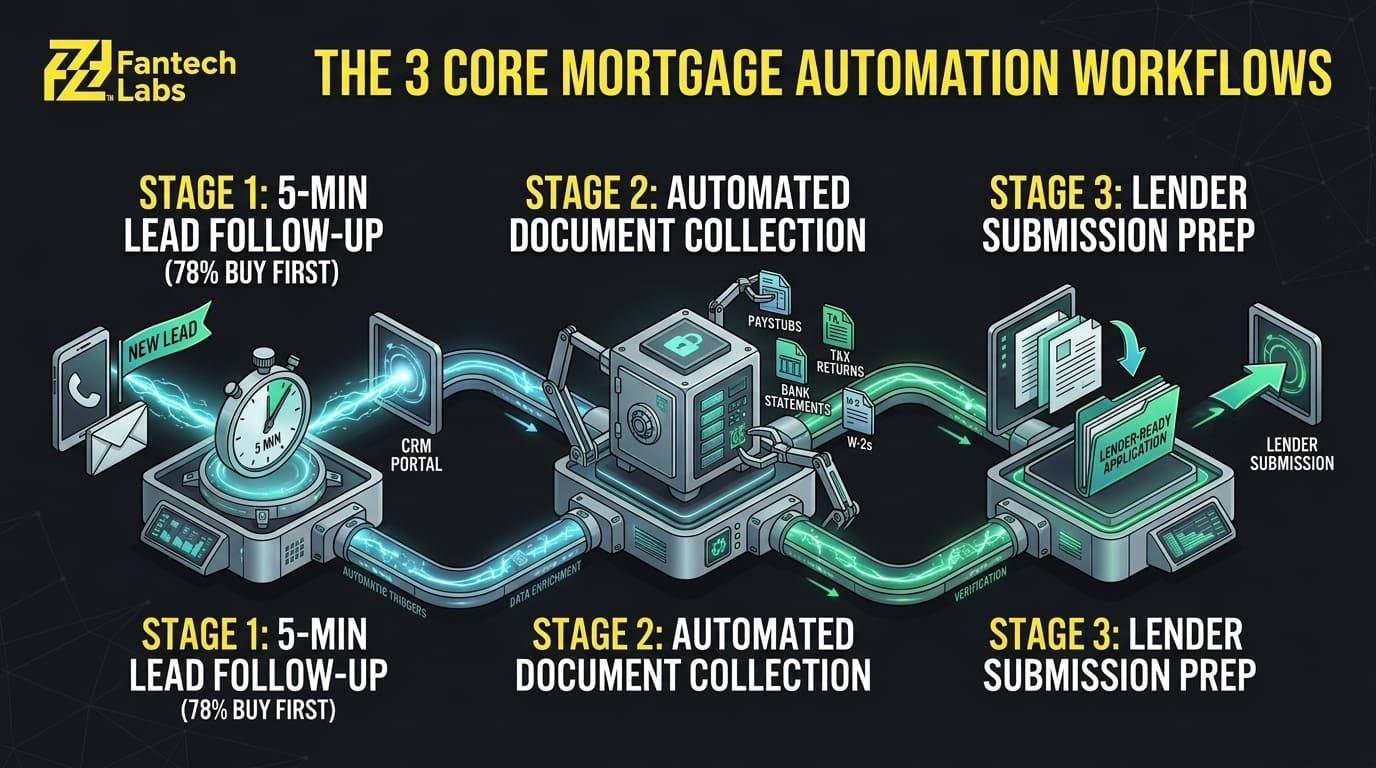
Fantech Labs has taken mortgage brokerage clients from 10 to 100-plus monthly deals by automating the manual work that sits between lead capture and lender submission. Every engagement starts with a process mapping session, not a sales pitch: understanding exactly how leads move through a specific brokerage today, where they stall, and which steps are already working before touching a single tool.
From there, the build typically follows the same sequence as the workflow table above: lead follow-up first, since it has the most direct effect on close rate and is usually the fastest to stand up, then document collection, then lender submission prep once the first two are proven out. Support continues after launch as a monthly retainer, since a brokerage's lender panel, document requirements, and CRM setup all shift over time and the automation needs to shift with them.
FREQUENTLY ASKED QUESTIONS
How much time can a mortgage brokerage actually save by automating?
Based on Fantech Labs' work with brokerage clients, brokers who automate lead follow-up, document collection, and lender submission report saving 15 to 20 hours per broker per week. That's largely time previously spent chasing documents, manually re-entering data across systems, and following up with leads by hand.
What's the ROI on automating a mortgage brokerage's workflows?
It varies by brokerage, but a representative build covering three workflows and five integrated tools delivered a 12-month ROI near 400% and a three-year net value above $170,000, from an upfront investment under $12,000, for one Fantech Labs mortgage brokerage client. The return comes from both reclaimed staff time and a higher close rate driven by faster lead response.
Which workflow should a mortgage brokerage automate first?
Lead follow-up, in almost every case. It has the most direct, measurable effect on close rate, since roughly 78% of customers buy from whichever company responds to their inquiry first. Document collection is a close second, since it's the most common source of deal delay.
How much does it cost to automate a brokerage's workflows?
Small brokerages automating two or three workflows should budget $1,000 to $3,500 per month for a managed service. Mid-market brokerages running a full multi-workflow stack should plan for $4,000 to $10,000 per month. A one-time build for three workflows and five integrated tools has run under $12,000 for Fantech Labs' brokerage clients.
How long does it take to get these workflows running?
Lead follow-up, document collection, and lender submission prep can typically be designed, built, and live within 4 to 6 weeks of an engagement starting, since they rely on connecting existing tools rather than building custom logic from scratch.
Should a small brokerage build automation in-house or hire a partner?
For a single, simple workflow like a basic lead-follow-up sequence, a technically comfortable staff member can often get something working with a no-code tool. Document collection and lender submission are riskier to DIY, since they touch more systems and tend to fail quietly on edge cases rather than obviously, which is usually where brokerages bring in a partner once the first workflow proves the concept.
SUMMARY
A mortgage brokerage's biggest deal-killer usually isn't rate or reputation, it's speed and follow-through on the repetitive steps between a lead coming in and a file landing at a lender. Automating lead follow-up, document collection, and lender submission targets exactly that gap, and the return shows up in two forms: hours a broker gets back every week, and deals that get won simply because the brokerage answered first. For most brokerages, the fastest path to a return is starting with the two workflows already costing them the most deals, lead follow-up and document collection, before expanding into a full multi-workflow build.
WHY TRUST THIS CONTENT
Fantech Labs is a Calgary-based AI automation and system integration company that has built lead follow-up, document collection, and lender submission automation specifically for mortgage brokerage clients across Canada. This piece is written by [AUTHOR NAME], [AUTHOR TITLE] at Fantech Labs. The ROI, cost, and time-savings figures above are drawn from Fantech Labs' own client engagements; the lead-response statistic is externally sourced and linked at the point it's used so it can be independently verified.
DISCLAIMER
Results vary by brokerage size, lead volume, existing tools, and how much of the current process is already digitized. The ROI, cost, and time-savings figures above reflect Fantech Labs' work with specific mortgage brokerage clients and are not a guarantee of results for every business. Talk to Fantech Labs directly for a scoped estimate based on your brokerage's actual workflows
Mussaddiq Mahmood | Automation Specialist & Tech Consultant Mussaddiq Mahmood is an Automation Specialist at Fantech Labs, dedicated to helping North American mortgage brokerages streamline their back-office operations. He specializes in building connected workflows that eliminate manual data entry, accelerate document collection, and help brokers scale their monthly deal flow efficiently.